
Textbook Question
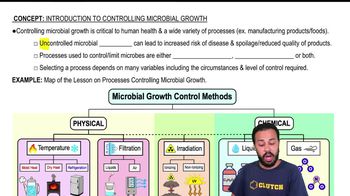
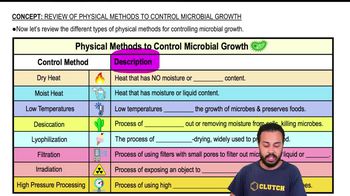
Which of the following is used to control microbial growth in foods?
a. Organic acids
b. Alcohols
c. Aldehydes
d. Heavy metals
e. All of the above
1068
views

 Verified step by step guidance
 04:56
04:56
 04:22
04:22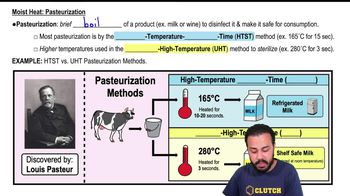 04:42
04:42Which of the following is used to control microbial growth in foods?
a. Organic acids
b. Alcohols
c. Aldehydes
d. Heavy metals
e. All of the above
How do salts and sugars preserve foods? Why are these considered physical rather than chemical methods of microbial control? Name one food that is preserved with sugar and one preserved with salt. How do you account for the occasional growth of Penicillium mold in jelly, which is 50% sucrose?
A bacterial culture was in log phase in the following figure. At time x, an antibacterial compound was added to the culture. Draw the lines indicating the addition of a bactericidal compound and a bacteriostatic compound. Explain why the viable count does not immediately drop to zero at x.
Use the following information to answer questions 6 and 7. The data were obtained from a use-dilution test comparing four disinfectants against Salmonella Choleraesuis.
G = growth, NG = no growth
Which disinfectant is the most effective?
Which of the following is not a characteristic of quaternary ammonium compounds?
a. Bactericidal against gram-positive bacteria
b. Sporicidal
c. Amebicidal
d. Fungicidal
e. Kills enveloped viruses
Use the following information to answer questions 6 and 7. The data were obtained from a use-dilution test comparing four disinfectants against Salmonella Choleraesuis.
G = growth, NG = no growth
Which disinfectant(s) is (are) bactericidal?
a. A,B,C, and D
b. A,C, and D
c. A only
d. B only
e. None of the above