
Ch. 19 - Disorders Associated with the Immune System
Tortora - Microbiology: An Introduction 14th Edition
Tortora14th EditionMicrobiology: An IntroductionISBN: 9780138200398Not the one you use?Change textbook
Chapter 19, Problem 8

In what ways do tumor cells differ antigenically from normal cells? Explain how tumor cells may be destroyed by the immune system.

Verified step by step guidance
1
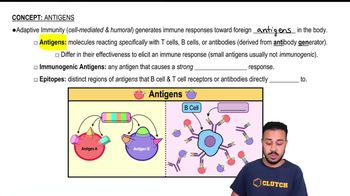
Understand that tumor cells differ antigenically from normal cells primarily because they express tumor-associated antigens (TAAs) or tumor-specific antigens (TSAs) that are either absent or present at much lower levels on normal cells. These antigens can arise due to mutations, altered protein expression, or abnormal glycosylation patterns.
Recognize that tumor-associated antigens can be classified into two main types: tumor-specific antigens, which are unique to tumor cells, and tumor-associated antigens, which are found in both normal and tumor cells but are overexpressed or aberrantly expressed in tumors.
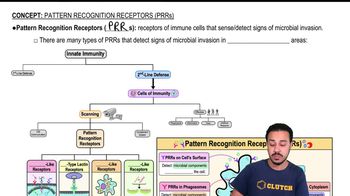
Explain that the immune system can recognize these abnormal antigens through antigen-presenting cells (APCs) that process tumor antigens and present them on major histocompatibility complex (MHC) molecules to T cells, initiating an immune response.
Describe how cytotoxic T lymphocytes (CTLs) recognize tumor antigens presented on MHC class I molecules of tumor cells and induce apoptosis in these cells by releasing perforin and granzymes or through Fas-FasL interactions.
Mention that natural killer (NK) cells can also destroy tumor cells, especially those with downregulated MHC class I molecules, by recognizing stress-induced ligands and releasing cytotoxic granules, thus contributing to immune surveillance against tumors.

Verified video answer for a similar problem:

This video solution was recommended by our tutors as helpful for the problem above.
Video duration:
2m
Was this helpful?

Key Concepts

Here are the essential concepts you must grasp in order to answer the question correctly.

Tumor-Specific and Tumor-Associated Antigens

Tumor cells express unique or altered proteins called tumor-specific antigens (TSAs) or tumor-associated antigens (TAAs) that are not present or are minimally expressed on normal cells. These antigens arise due to mutations or abnormal gene expression, allowing the immune system to distinguish tumor cells from healthy cells.
Recommended video:

Immune Recognition and Activation

The immune system recognizes tumor antigens through antigen-presenting cells that process and present these antigens to T cells. This activates cytotoxic T lymphocytes (CTLs) and helper T cells, initiating an immune response targeted specifically against tumor cells displaying these abnormal antigens.
Recommended video:
Guided course
04:24
Pattern Recognition Receptors

Mechanisms of Tumor Cell Destruction

Activated cytotoxic T cells kill tumor cells by inducing apoptosis through perforin and granzymes or by engaging death receptors. Additionally, natural killer (NK) cells and antibody-dependent cellular cytotoxicity (ADCC) contribute to tumor cell elimination, highlighting multiple immune pathways involved in tumor destruction.
Recommended video:
Guided course
01:59
Introduction to Avoiding Host Defense Mechanisms