Ch. 9 - Biotechnology & DNA Technology
Tortora - Microbiology: An Introduction 14th Edition
Tortora14th EditionMicrobiology: An IntroductionISBN: 9780138200398Not the one you use?Change textbook
Chapter 9, Problem 3

Which of the following is the fourth basic step to genetically modify a cell?
a. Transformation
b. Ligation
c. Plasmid cleavage
d. Restriction-enzyme digestion of gene
e. Isolation of gene

Verified step by step guidance
1
Understand the general sequence of steps involved in genetically modifying a cell. Typically, the process includes: (1) isolation of the gene of interest, (2) restriction-enzyme digestion of the gene, (3) plasmid cleavage, (4) ligation, and (5) transformation.
Step 1: Isolation of the gene involves extracting the specific DNA segment that you want to insert into the host cell.
Step 2: Restriction-enzyme digestion of the gene means cutting the isolated gene at specific sequences using restriction enzymes to create compatible ends for insertion.
Step 3: Plasmid cleavage refers to cutting the plasmid vector with the same restriction enzymes to open it up for the insertion of the gene.
Step 4: Ligation is the process of joining the gene fragment and the plasmid vector together using the enzyme DNA ligase, forming a recombinant DNA molecule ready for introduction into the host cell.

Verified video answer for a similar problem:

This video solution was recommended by our tutors as helpful for the problem above.
Video duration:
2m
Was this helpful?

Key Concepts

Here are the essential concepts you must grasp in order to answer the question correctly.

Steps in Genetic Modification

Genetic modification involves a series of steps to alter an organism's DNA. These typically include isolating the gene of interest, cutting DNA with restriction enzymes, ligating the gene into a vector, and introducing the recombinant DNA into a host cell via transformation.
Recommended video:

Restriction Enzymes and DNA Cleavage

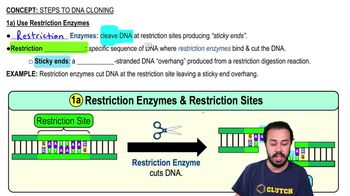
Restriction enzymes are proteins that cut DNA at specific sequences, enabling precise excision of genes. This step is crucial for preparing both the gene of interest and the plasmid vector for ligation, ensuring compatible ends for joining.
Recommended video:
Guided course
03:27
1a) Use Restriction Enzymes

Transformation in Genetic Engineering

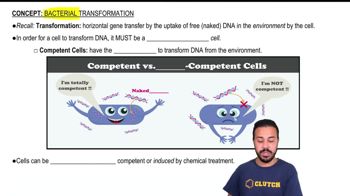
Transformation is the process of introducing recombinant DNA into a host cell, often bacteria, allowing the cell to express the new gene. It is typically the final step after constructing the recombinant plasmid, enabling propagation and study of the modified gene.
Recommended video:
Guided course
03:06
Bacterial Transformation