Ch. 12 - The Eukaryotes: Fungi, Algae, Protozoa, and Helminths
Tortora - Microbiology: An Introduction 14th Edition
Tortora14th EditionMicrobiology: An IntroductionISBN: 9780138200398Not the one you use?Change textbook
Chapter 12, Problem 9

Most roundworms are dioecious. What does this term mean? To what phylum do roundworms belong?

Verified step by step guidance
1
Understand the term 'dioecious': In biology, 'dioecious' refers to a species in which individual organisms are distinctly male or female, meaning that each organism has only one type of reproductive organ (either male or female), not both.
Apply this definition to roundworms: Since most roundworms are dioecious, it means that individual roundworms are either male or female, and reproduction requires two separate individuals of opposite sexes.
Identify the phylum of roundworms: Roundworms belong to the phylum Nematoda, which is characterized by elongated, cylindrical, unsegmented bodies and a complete digestive system.
Summarize the answer: Most roundworms are dioecious, meaning they have separate sexes, and they belong to the phylum Nematoda.
Optional extension: Recognize that being dioecious is an important reproductive strategy that promotes genetic diversity through sexual reproduction.

Verified video answer for a similar problem:

This video solution was recommended by our tutors as helpful for the problem above.
Was this helpful?

Key Concepts

Here are the essential concepts you must grasp in order to answer the question correctly.

Dioecious Organisms

Dioecious organisms have distinct male and female individuals, each producing only one type of gamete (sperm or eggs). This means reproduction requires two separate sexes, unlike hermaphroditic species that possess both reproductive organs.
Recommended video:
Guided course
05:22
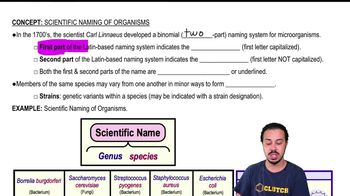
Scientific Naming of Organisms

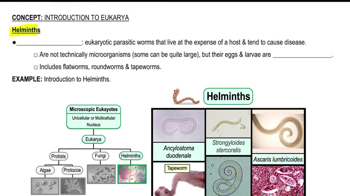
Roundworms (Nematodes)

Roundworms, or nematodes, are a diverse group of unsegmented, cylindrical worms with a complete digestive system. They are mostly free-living or parasitic and are characterized by their tough outer cuticle and pseudocoelom body cavity.
Recommended video:

Phylum Nematoda

Phylum Nematoda includes roundworms, which are bilaterally symmetrical, triploblastic, and pseudocoelomate animals. They play important ecological roles and include many species that are parasites of plants and animals.
Recommended video:
Guided course
02:19
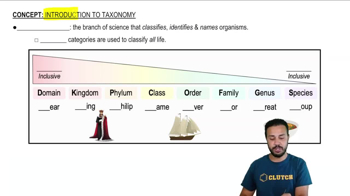
Introduction to Taxonomy