
Textbook Question
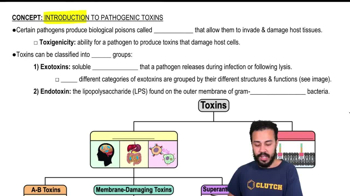
Compare and contrast the following aspects of endotoxins and exotoxins: bacterial source, chemistry, toxigenicity, and pharmacology. Give an example of each toxin.
1549
views

 Verified step by step guidance
 03:40
03:40
 01:52
01:52 03:35
03:35Compare and contrast the following aspects of endotoxins and exotoxins: bacterial source, chemistry, toxigenicity, and pharmacology. Give an example of each toxin.
How are capsules and cell wall components related to pathogenicity? Give specific examples.
Describe how hemolysins, leukocidins, coagulase, kinases, hyaluronidase, siderophores, and IgA proteases might contribute to pathogenicity.
Which of the following is not a portal of entry for pathogens?
a. Mucous membranes of the respiratory tract
b. Mucous membranes of the digestive canal
c. Skin
d. Blood
e. Parenteral route
All of the following are related to bacterial infection. Which would prevent all of the others?
a. Vaccination against fimbriae
b. Phagocytosis
c. Inhibition of phagocytic digestion
d. Destruction of adhesins
e. Alteration of cytoskeleton
The ID₅₀ for Campylobacter sp. is 500 cells; the ID₅₀ for Cryptosporidium sp. is 100 cells. Which of the following statements is false?
a. Both microbes are pathogens.
b. Both microbes produce infections in 50% of the inoculated hosts.
c. Campylobacter is more virulent than Cryptosporidium.
d. Campylobacter and Cryptosporidium are equally virulent; they cause infections in the same number of test animals.
e. Cryptosporidium infections are acquired more easily than Campylobacter infections.