Ch. 9 - Biotechnology & DNA Technology
Tortora - Microbiology: An Introduction 14th Edition
Tortora14th EditionMicrobiology: An IntroductionISBN: 9780138200398Not the one you use?Change textbook
Chapter 9, Problem 3

Some commonly used restriction enzymes are listed in Table 9.1.
a. Indicate which enzymes produce sticky ends.
b. Of what value are sticky ends in making rDNA?

Verified step by step guidance
1
Step 1: Understand what sticky ends are. Sticky ends are single-stranded overhangs produced when certain restriction enzymes cut DNA at specific sequences in a staggered manner, leaving unpaired nucleotides at the ends.
Step 2: Identify which enzymes produce sticky ends by examining the recognition and cutting patterns of each enzyme listed in Table 9.1. Enzymes that cut asymmetrically within their recognition sites generate sticky ends, while those that cut symmetrically produce blunt ends.
Step 3: For each enzyme, analyze the DNA sequence it recognizes and determine if the cut results in overhanging single-stranded ends (sticky ends) or flush ends (blunt ends).
Step 4: Explain the value of sticky ends in recombinant DNA (rDNA) technology. Sticky ends facilitate the joining of DNA fragments from different sources because their complementary overhangs can base-pair, allowing DNA ligase to seal the backbone efficiently.
Step 5: Summarize that sticky ends increase the specificity and efficiency of DNA fragment ligation, making them highly valuable tools in cloning and genetic engineering.

Verified video answer for a similar problem:

This video solution was recommended by our tutors as helpful for the problem above.
Video duration:
1m
Was this helpful?

Key Concepts

Here are the essential concepts you must grasp in order to answer the question correctly.

Restriction Enzymes and Their Types

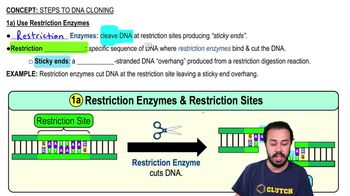
Restriction enzymes are proteins that cut DNA at specific sequences. They can produce either sticky ends, which have overhanging single-stranded DNA, or blunt ends, which are straight cuts without overhangs. Understanding the type of ends produced is essential for DNA manipulation.
Recommended video:
Guided course
03:27
1a) Use Restriction Enzymes

Sticky Ends

Sticky ends are single-stranded overhangs created by staggered cuts in DNA. These overhangs can base-pair with complementary sequences, facilitating the joining of DNA fragments from different sources. Sticky ends increase the efficiency and specificity of DNA ligation.
Recommended video:
Guided course
03:27
1a) Use Restriction Enzymes

Role of Sticky Ends in Recombinant DNA (rDNA) Technology

Sticky ends are valuable in rDNA technology because they allow DNA fragments from different origins to anneal through complementary base pairing. This property enables the creation of recombinant molecules by ligating compatible sticky ends, which is crucial for cloning and genetic engineering.
Recommended video:
Guided course
03:12
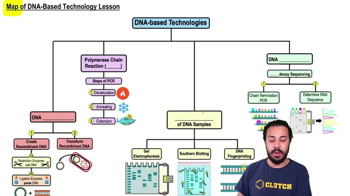
Map of DNA-Based Technology Lesson