
Ch. 10 - Classification of Microorganisms
Tortora - Microbiology: An Introduction 14th Edition
Tortora14th EditionMicrobiology: An IntroductionISBN: 9780138200398Not the one you use?Change textbook
Chapter 10, Problem 2

Bacillus and Lactobacillus are not in the same order. This indicates that which one of the following is not sufficient to assign an organism to a taxon?
a. Biochemical characteristics
b. Amino acid sequencing
c. Phage typing
d. Serology
e. Morphological characteristics

Verified step by step guidance
1
Understand that taxonomic classification in microbiology is based on multiple criteria, including genetic, biochemical, morphological, and serological characteristics.
Recognize that Bacillus and Lactobacillus belong to different orders, meaning they are classified at a higher taxonomic level based on significant differences.
Consider that morphological characteristics (such as shape and staining) can sometimes be similar between different genera or orders, which may lead to misclassification if used alone.
Evaluate the options given: biochemical characteristics, amino acid sequencing, phage typing, serology, and morphological characteristics, and determine which method alone might not be sufficient to accurately assign an organism to the correct taxon.
Conclude that morphological characteristics alone are often not sufficient for precise taxonomic assignment because different organisms can share similar shapes or structures despite being genetically distinct.

Verified video answer for a similar problem:

This video solution was recommended by our tutors as helpful for the problem above.
Video duration:
2m
Was this helpful?

Key Concepts

Here are the essential concepts you must grasp in order to answer the question correctly.

Taxonomic Classification and Hierarchy

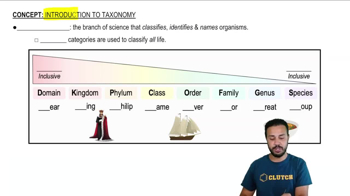
Taxonomy organizes organisms into hierarchical groups like domain, kingdom, phylum, class, order, family, genus, and species. Organisms in different orders have significant genetic and evolutionary differences, so accurate classification requires multiple lines of evidence beyond superficial traits.
Recommended video:
Guided course
03:09
Hierarchy of Microbial Growth Control Terminology

Limitations of Morphological Characteristics in Classification

Morphological characteristics refer to the physical traits of organisms, such as shape and structure. While useful for initial identification, these traits can be misleading due to convergent evolution or phenotypic plasticity, making morphology alone insufficient for precise taxonomic placement.
Recommended video:
Guided course
02:44
Types of Bacterial Cell Morphology

Molecular and Biochemical Methods in Taxonomy

Techniques like amino acid sequencing, biochemical tests, serology, and phage typing analyze genetic or molecular features, providing more reliable data for classification. These methods help distinguish organisms with similar morphology but different evolutionary backgrounds.
Recommended video:
Guided course
02:19
Introduction to Taxonomy