A reaction has a rate constant of 0.000122/s at 27 °C and 0.228/s at 77 °C. b. What is the value of the rate constant at 17 °C?
Ch.14 - Chemical Kinetics
Chapter 14, Problem 67
The tabulated data were collected for the second-order reaction: Cl(g) + H2(g) → HCl(g) + H(g). Use an Arrhenius plot to determine the activation barrier and frequency factor for the reaction. Temperature (K) and Rate Constant (L/mol # s) are as follows: 90 K, 0.00357; 100 K, 0.0773; 110 K, 0.956; 120 K, 7.781.
Verified step by step guidance1
Convert the given temperatures from Kelvin to the reciprocal of temperature in Kelvin (1/T) for each data point.
Take the natural logarithm of the rate constant (k) for each temperature to obtain ln(k).
Plot ln(k) on the y-axis against 1/T on the x-axis to create the Arrhenius plot.
Determine the slope of the line from the Arrhenius plot, which is equal to -Ea/R, where Ea is the activation energy and R is the universal gas constant (8.314 J/mol K).
Calculate the activation energy (Ea) using the slope, and determine the frequency factor (A) by finding the y-intercept of the line, which is equal to ln(A).
Key Concepts
Here are the essential concepts you must grasp in order to answer the question correctly.
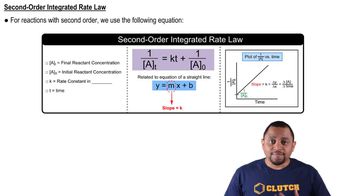
Second-Order Reactions
Second-order reactions are chemical reactions where the rate is proportional to the square of the concentration of one reactant or the product of the concentrations of two reactants. In this case, the reaction between Cl(g) and H2(g) is second-order, meaning that the rate constant (k) will depend on the concentrations of both reactants. Understanding this concept is crucial for analyzing the rate data provided.
Recommended video:
Guided course
Second-Order Reactions
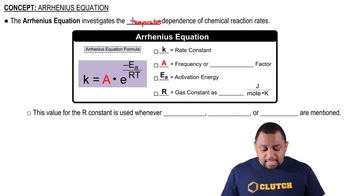
Arrhenius Equation
The Arrhenius equation relates the rate constant of a reaction to the temperature and activation energy. It is expressed as k = A * e^(-Ea/RT), where k is the rate constant, A is the frequency factor, Ea is the activation energy, R is the universal gas constant, and T is the temperature in Kelvin. This equation is fundamental for determining the activation barrier and frequency factor from the provided rate constants at different temperatures.
Recommended video:
Guided course
Arrhenius Equation
Activation Energy
Activation energy (Ea) is the minimum energy required for a chemical reaction to occur. It represents the energy barrier that reactants must overcome to form products. In the context of the Arrhenius plot, a linear relationship between ln(k) and 1/T allows for the determination of Ea from the slope of the line, which is essential for understanding the kinetics of the given reaction.
Recommended video:
Guided course
Activity Series Chart
Related Practice
Textbook Question
2142
views
Textbook Question
A reaction has a rate constant of 0.0117/s at 400.0 K and 0.689/s at 450.0 K. a. Determine the activation barrier for the reaction.
2476
views
8
rank
Textbook Question
The data shown here were collected for the first-order reaction: N2O(g) → N2(g) + O(g) Use an Arrhenius plot to determine the activation barrier and frequency factor for the reaction.
Temperature (K) Rate Constant (1 , s)
800 3.24⨉10- 5
900 0.00214
1000 0.0614
1100 0.955
1575
views
Textbook Question
The tabulated data show the rate constant of a reaction measured at several different temperatures. Use an Arrhenius plot to determine the activation barrier and frequency factor for the reaction.
Temperature (K) Rate Constant (1 , s)
300 0.0134
310 0.0407
320 0.114
330 0.303
340 0.757
2534
views