Start by rewriting the expression clearly: \(12x^{-\frac{1}{2}} + 6x^{-\frac{3}{2}}\).
Identify the common factor in both terms. Look at the coefficients (12 and 6) and the powers of \(x\) (\(x^{-\frac{1}{2}}\) and \(x^{-\frac{3}{2}}\)).
Factor out the greatest common factor (GCF). The GCF of 12 and 6 is 6, and for the powers of \(x\), take the smaller exponent \(x^{-\frac{3}{2}}\) as the common factor.
Rewrite each term inside the parentheses by dividing the original terms by the GCF: \(6x^{-\frac{3}{2}} \left( \frac{12x^{-\frac{1}{2}}}{6x^{-\frac{3}{2}}} + \frac{6x^{-\frac{3}{2}}}{6x^{-\frac{3}{2}}} \right)\).
Simplify the terms inside the parentheses by subtracting exponents when dividing powers of \(x\) and simplifying coefficients, resulting in a factored and simplified expression.
Verified video answer for a similar problem:
This video solution was recommended by our tutors as helpful for the problem above
Video duration:
3m
Play a video:
0 Comments
Key Concepts
Here are the essential concepts you must grasp in order to answer the question correctly.
Negative Exponents
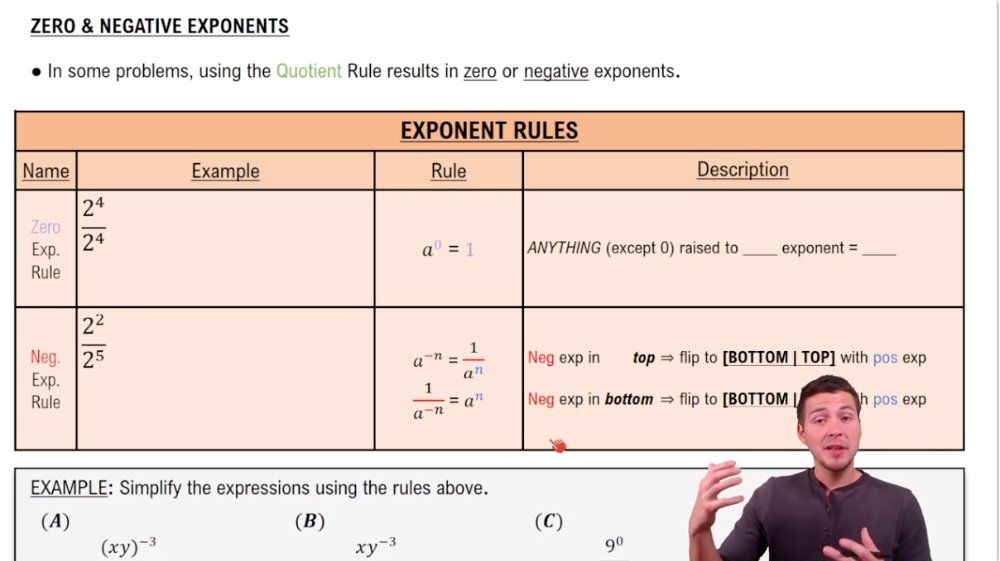
Negative exponents indicate the reciprocal of the base raised to the positive exponent. For example, x^(-n) equals 1 divided by x^n. Understanding this helps in rewriting and simplifying expressions involving negative powers.
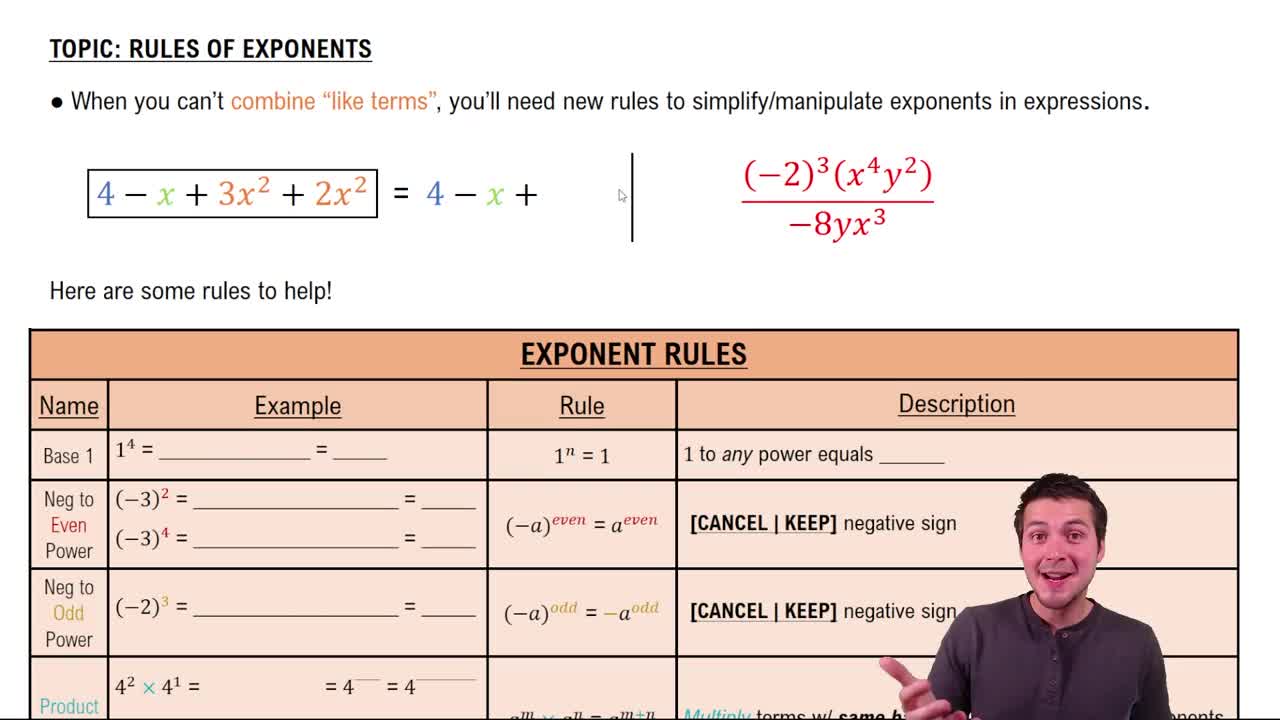
Factoring involves finding the greatest common factor (GCF) of terms and expressing the expression as a product of factors. This process simplifies expressions and makes further operations easier, such as combining like terms or simplifying.
When terms have the same base and exponent, they can be combined by adding or subtracting their coefficients. Recognizing like terms with fractional or negative exponents is essential for simplifying algebraic expressions correctly.

 3:42 minutes
 Verified step by step guidance
 6:37
6:37