
Textbook Question
In Exercises 103–110, insert either <, >, or = in the shaded area to make a true statement. |−20| □ |−50|
865
views

 Verified step by step guidance
 6:37
6:37
 05:09
05:09 03:50
03:50In Exercises 103–110, insert either <, >, or = in the shaded area to make a true statement. |−20| □ |−50|
Simplify by reducing the index of the radical.
In Exercises 103–114, factor completely. 6x4+35x2−6
Perform the indicated computations. Write the answers in scientific notation. If necessary, round the decimal factor in your scientific notation answer to two decimal places. (66,000×0.001)/(0.003×0.002)
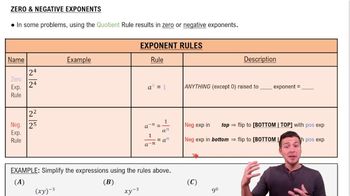
Simplify each exponential expression. Assume that variables represent nonzero real numbers.
Perform the indicated computations. Write the answers in scientific notation. If necessary, round the decimal factor in your scientific notation answer to two decimal places. 282,000,000,000/0.00141