Recognize that the expression is a difference of cubes: \( (x+y)^3 - (x-y)^3 \). This suggests using the formula for the difference of cubes: \(a^3 - b^3 = (a - b)(a^2 + ab + b^2)\), where \(a = (x+y)\) and \(b = (x-y)\).
Apply the difference of cubes formula: write the expression as \(((x+y) - (x-y)) \times ((x+y)^2 + (x+y)(x-y) + (x-y)^2)\).
Simplify the first factor: \(((x+y) - (x-y)) = x + y - x + y = 2y\).
Expand and simplify each term inside the second factor: calculate \((x+y)^2\), \((x+y)(x-y)\), and \((x-y)^2\) separately.
Combine the expanded terms inside the second factor and simplify the expression to get the fully factored form.
Verified video answer for a similar problem:
This video solution was recommended by our tutors as helpful for the problem above
Video duration:
4m
Play a video:
0 Comments
Key Concepts
Here are the essential concepts you must grasp in order to answer the question correctly.
Difference of Cubes
The difference of cubes formula states that a³ - b³ = (a - b)(a² + ab + b²). Recognizing expressions in the form of cubes allows factoring complex polynomials efficiently. In this problem, (x + y)³ and (x - y)³ are perfect cubes, enabling the use of this formula.
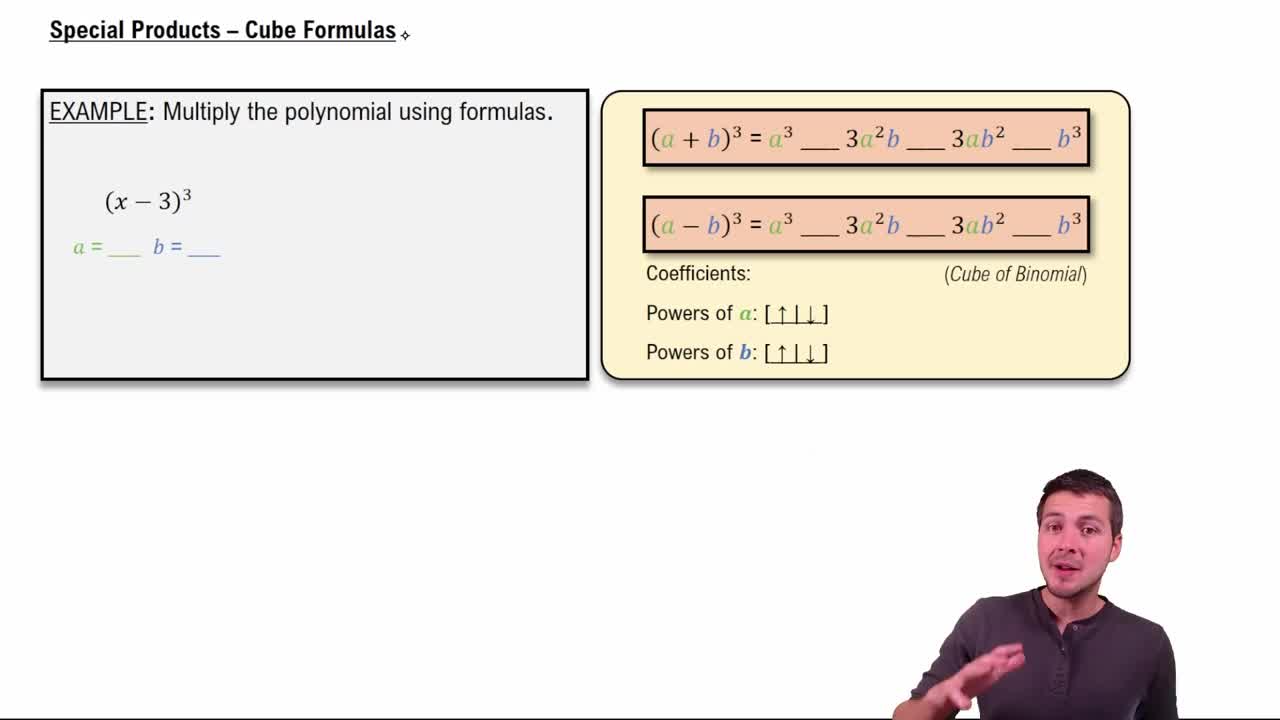
Binomial expansion involves expanding expressions raised to a power, such as (x + y)³, using the binomial theorem or Pascal's triangle. Understanding the expanded form helps in verifying factorizations and simplifying expressions.
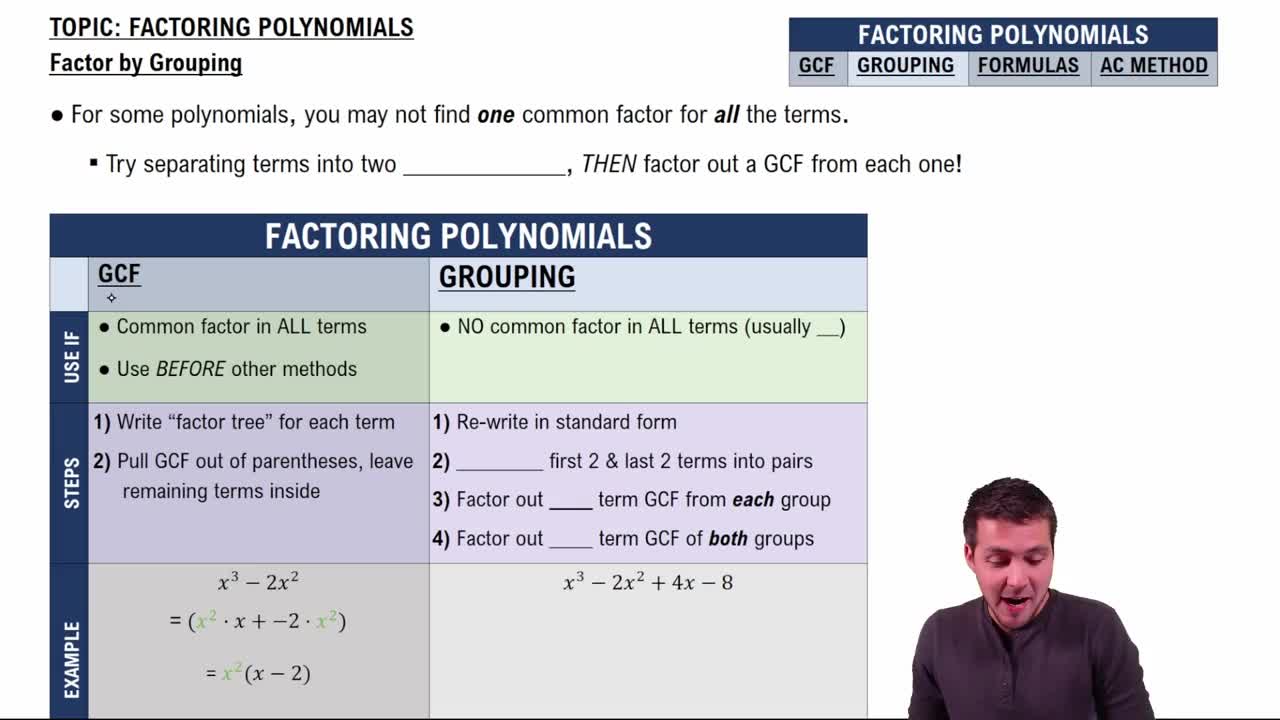
Factoring by grouping involves rearranging and grouping terms to find common factors. After applying the difference of cubes formula, grouping terms can simplify the expression further, making it easier to factor completely.

 4:12 minutes
 Verified step by step guidance
 03:41
03:41