Factor by any method. See Examples 1–7. (3a+5)2-18(3a+5)+81
Verified step by step guidance
1
Recognize that the expression is a quadratic in terms of the binomial \(3a + 5\). Let \(x = 3a + 5\) to simplify the expression to \(x^2 - 18x + 81\).
Rewrite the expression using the substitution: \(x^2 - 18x + 81\). Now, focus on factoring this quadratic expression.
Look for two numbers that multiply to \(81\) and add up to \(-18\). These numbers will help factor the quadratic into the form \((x - m)(x - n)\).
Once the quadratic is factored as \((x - m)(x - n)\), substitute back \(x = 3a + 5\) to get the factors in terms of \(a\).
Write the final factored form as \((3a + 5 - m)(3a + 5 - n)\), which is the factorization of the original expression.
Verified video answer for a similar problem:
This video solution was recommended by our tutors as helpful for the problem above
Video duration:
3m
Play a video:
0 Comments
Key Concepts
Here are the essential concepts you must grasp in order to answer the question correctly.
Substitution Method
The substitution method involves replacing a complex expression with a single variable to simplify the factoring process. In this problem, letting x = (3a + 5) transforms the expression into a quadratic form, making it easier to factor.
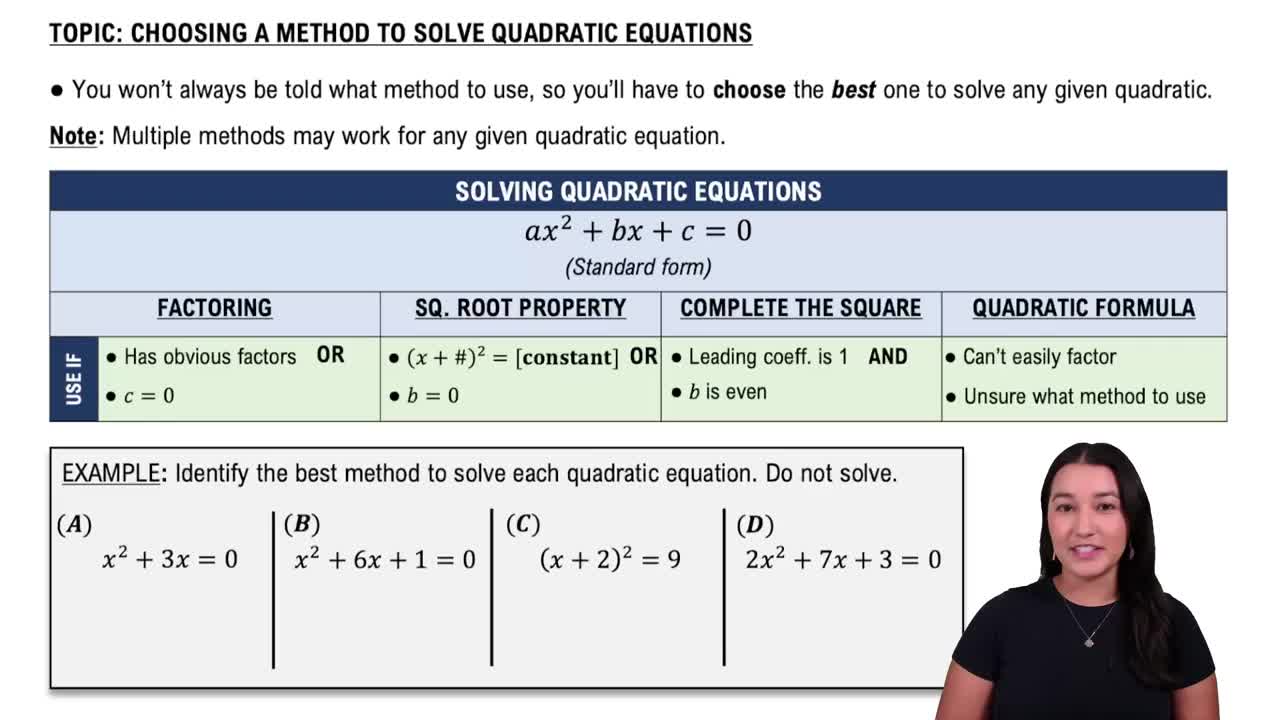
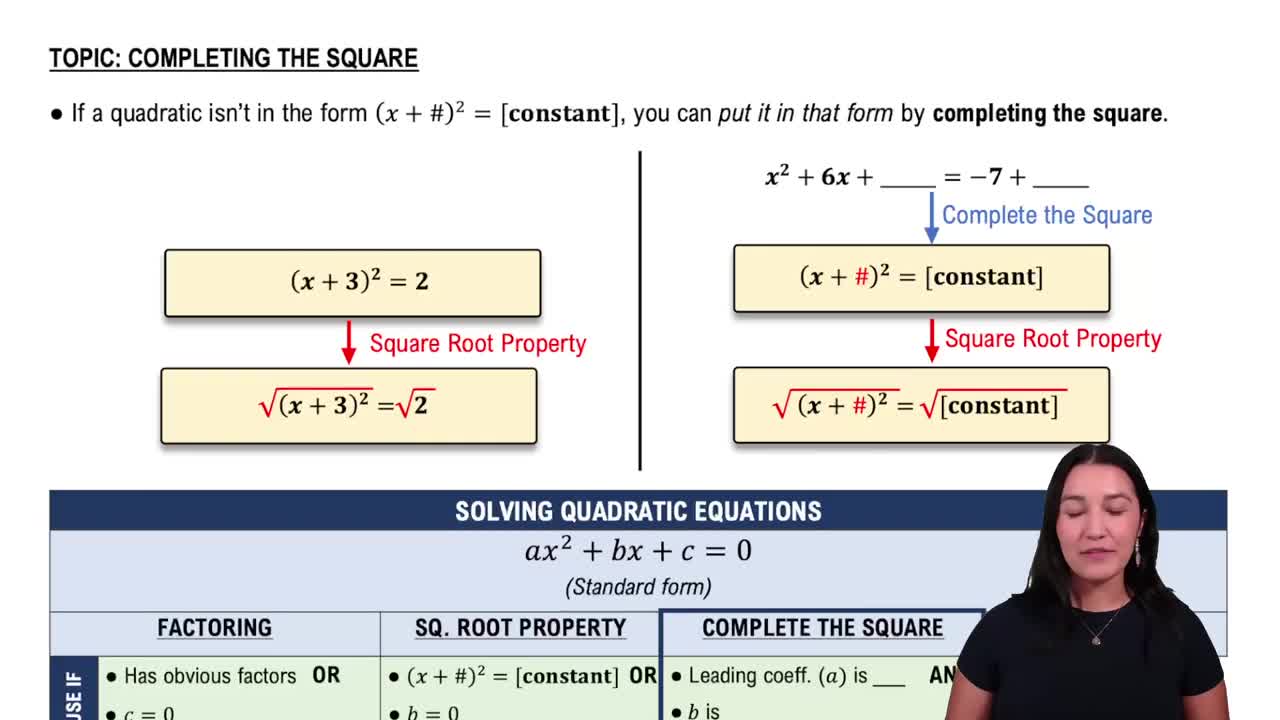
Factoring quadratics means rewriting a quadratic expression as a product of two binomials. Recognizing the standard form ax^2 + bx + c allows you to find factors of c that add up to b, or use methods like completing the square or the quadratic formula.
Difference of Squares and Perfect Square Trinomials
Understanding special factoring patterns like difference of squares and perfect square trinomials helps quickly factor expressions. For example, recognizing if the quadratic is a perfect square trinomial can simplify factoring without trial and error.