Ch. 8 - Energy and Enzymes: An Introduction to Metabolism
Freeman - Biological Science 8th Edition
Freeman8th EditionBiological ScienceISBN: 9780138276263Not the one you use?Change textbook
Chapter 8, Problem 6

If you were to expose glucose to oxygen on your lab bench, why would you not expect to see it burn as described by the reaction in Figure 8.6?
a. The reaction is endergonic and requires an input of energy.
b. The reaction is not spontaneous unless an enzyme is added.
c. The sugar must first be phosphorylated to increase its potential energy.
d. Activation energy is required for the sugar and oxygen to reach their transition state.

Verified step by step guidance
1
Understand the chemical reaction: The reaction between glucose and oxygen is a redox reaction where glucose is oxidized to carbon dioxide and oxygen is reduced to water, releasing energy.
Identify the nature of the reaction: The reaction is exergonic, meaning it releases energy, as shown by the release of energy in the form of heat and light in the diagram.
Consider the role of activation energy: Even though the reaction is exergonic, it requires an initial input of energy to overcome the activation energy barrier, allowing the reactants to reach the transition state.
Recognize the need for a catalyst: In biological systems, enzymes act as catalysts to lower the activation energy, making the reaction proceed at a noticeable rate. Without an enzyme, the reaction would be too slow to observe under normal conditions.
Conclude why the reaction doesn't occur spontaneously on the lab bench: Without an enzyme or sufficient activation energy, the reaction between glucose and oxygen will not proceed spontaneously, which is why you wouldn't see it burn on the lab bench.

Verified video answer for a similar problem:

This video solution was recommended by our tutors as helpful for the problem above.
Video duration:
2m
Was this helpful?

Key Concepts

Here are the essential concepts you must grasp in order to answer the question correctly.

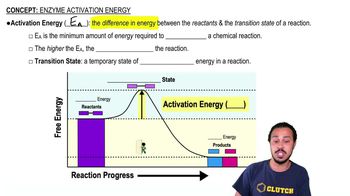
Activation Energy

Activation energy is the minimum energy required for a chemical reaction to occur. In the case of glucose burning in the presence of oxygen, this energy is necessary to initiate the reaction, allowing the reactants to reach a transition state where they can transform into products. Without sufficient activation energy, the reaction will not proceed, even if the reactants are present.
Recommended video:
Guided course
04:18
Enzyme Activation Energy

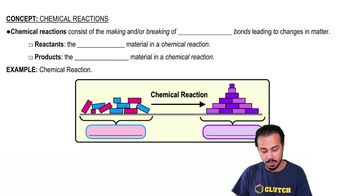
Spontaneity of Reactions

A spontaneous reaction is one that occurs without the need for continuous external energy input. While the combustion of glucose is exothermic and releases energy, it is not spontaneous at room temperature without a catalyst or sufficient activation energy. Understanding the conditions under which a reaction becomes spontaneous is crucial for predicting its behavior in a lab setting.
Recommended video:
Guided course
01:56
Chemical Reactions

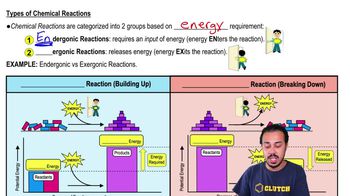
Endergonic vs. Exergonic Reactions

Endergonic reactions require an input of energy to proceed, while exergonic reactions release energy. The combustion of glucose is typically exergonic, but the initial activation energy needed to start the reaction can make it seem endergonic until that threshold is met. Recognizing the energy dynamics of these reactions helps clarify why glucose does not spontaneously ignite in the presence of oxygen.
Recommended video:
Guided course
05:48
Types of Chemical Reactions
Related Practice
Textbook Question

How does pH affect enzyme-catalyzed reactions?

a. Protons serve as substrates for most reactions.

b. Energy stored in protons is used to drive endergonic reactions.

c. Proton concentration increases the kinetic energy of the reactants, enabling them to reach their transition state.

d. The concentration of protons affects an enzyme's folded structure and reactivity.

1730
views
Textbook Question

Explain how feedback inhibition regulates metabolic pathways.

1490
views
Textbook Question

Explain the lock-and-key model of enzyme activity. What is incorrect about this model?

2040
views
Textbook Question

In Figure 8.10, the energetic coupling of substrate phosphorylation and an endergonic reaction are shown. If the hydrolysis of ATP releases 7.3 kcal of free energy, use the graph in this figure to estimate what you would expect the ∆G values to be for the uncoupled reaction and the two steps in the coupled reaction.


1685
views
Textbook Question

Using what you have learned about changes in Gibbs free energy, would you predict the ∆G value of catabolic reactions to be positive or negative? What about anabolic reactions? Justify your answers using the terms 'enthalpy' and 'entropy.'

1965
views
Textbook Question

Draw a chemical equation to represent the redox reaction that occurs when methane (CH4) burns in the presence of oxygen (O2). Identify the reactant that is reduced and the reactant that is oxidized. Of the four molecules that should be in your equation, point out the one that has bonds with the highest potential energy.

1929
views
1
rank