Ch. 53 - Ecosystems and Global Ecology
Freeman - Biological Science 8th Edition
Freeman8th EditionBiological ScienceISBN: 9780138276263Not the one you use?Change textbook
Chapter 53, Problem 8

Explain why it is more energy efficient (in terms of the amount of total NPP required) to eat a pound of tofu (bean curd) than a pound of hamburger.

Verified step by step guidance
1
Step 1: Understand the concept of Net Primary Productivity (NPP). NPP is the amount of energy that plants, or primary producers, store as biomass after accounting for the energy they use during respiration. This energy is available to the next trophic level in the food chain, which are the herbivores or primary consumers.
Step 2: Recognize that energy transfer between trophic levels is inefficient. Only about 10% of the energy stored as biomass in one trophic level is transferred to the next. This is known as the 10% rule in ecology.
Step 3: Understand that tofu is made from soybeans, which are primary producers. When we consume tofu, we are consuming energy directly from the first trophic level.
Step 4: Understand that a hamburger is made from beef, which comes from cows. Cows are primary consumers, as they eat grass, a primary producer. When we consume a hamburger, we are consuming energy from the second trophic level.
Step 5: Conclude that eating a pound of tofu requires less total NPP than eating a pound of hamburger because energy transfer between trophic levels is inefficient. By eating tofu, we are consuming energy directly from the first trophic level, whereas eating a hamburger involves an additional step of energy transfer, resulting in more energy loss.

Verified video answer for a similar problem:

This video solution was recommended by our tutors as helpful for the problem above.
Video duration:
2m
Was this helpful?

Key Concepts

Here are the essential concepts you must grasp in order to answer the question correctly.

Net Primary Productivity (NPP)

Net Primary Productivity (NPP) refers to the amount of organic matter or biomass produced by plants through photosynthesis, minus the energy used in respiration. It is a crucial measure of ecosystem productivity, indicating how much energy is available to support herbivores and higher trophic levels. Higher NPP means more energy is available for consumption, making plant-based foods like tofu generally more energy-efficient than animal-based foods.
Recommended video:
Guided course
04:36
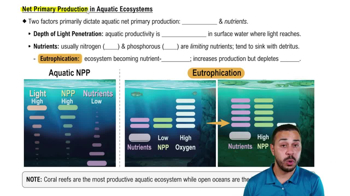
Primary Production in Aquatic Ecosystems

Trophic Levels

Trophic levels represent the hierarchical positions in a food chain, where energy is transferred from producers to consumers. In a typical food chain, energy decreases as it moves up trophic levels due to energy loss at each stage, primarily through metabolic processes. Since tofu is derived from plants (producers), it requires less energy input compared to hamburger, which comes from animals (higher trophic levels) that consume multiple levels of plants.
Recommended video:
Guided course
03:14
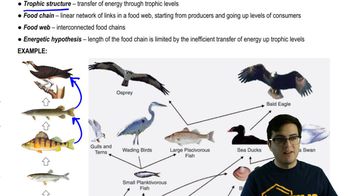
Trophic Structure

Energy Transfer Efficiency

Energy transfer efficiency refers to the percentage of energy that is passed from one trophic level to the next. This efficiency is typically low, averaging around 10%, meaning that only a small fraction of energy is available to the next level. Consequently, consuming plant-based foods like tofu is more energy-efficient than consuming animal products like hamburger, as less total NPP is required to produce the same amount of food.
Recommended video:
Guided course
06:28
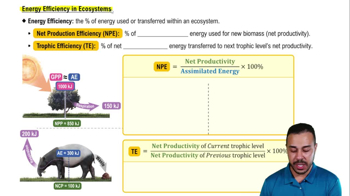
Energy Efficiency in Ecosystems
Related Practice
Textbook Question

If the GPP of a grassland is 5000 kcal/m2/year and 55 percent is used up by cellular respiration, what is the NPP?

a. 2250 kcal/m2/year

b. 2750 kcal/m2/year

c. 5000 kcal/m2/year

d. Need more data

1585
views
Textbook Question

Explain why decomposition rates in a field in Nebraska would differ from the decomposition rates in a field in the Amazon. How do decomposers regulate nutrient availability in ecosystems?

779
views
Textbook Question

Why are the open oceans nutrient poor? Why are coastal areas and intertidal habitats relatively nutrient rich?

1302
views
Textbook Question

Suppose that record snows blanket your campus this winter. Your friend says this is proof that global warming isn't really occurring. What is the flaw in your friend's logic?

a. The average temperature of the Earth is not actually increasing.

b. Global warming refers to temperatures, but snow is a type of precipitation.

c. While the average global temperature is increasing, local temperatures and precipitation (weather) will vary.

d. Your friend is confusing global warming and global climate change.

820
views
Textbook Question

During the Carboniferous period, plant growth was extensive but rates of decomposition slowed (probably due to the formation of vast, oxygen-poor swamp habitats). As a result, large amounts of biomass accumulated in terrestrial environments (much of this biomass is now coal). The fossil record indicates that atmospheric oxygen increased, atmospheric carbon dioxide decreased, and global temperatures dropped. Explain why.

1243
views
Textbook Question

Scientists around the world are collaborating to understand how deforestation, climate change, and natural processes will interact to affect one of the most productive and biodiverse ecosystems on Earth.

Which of the following biomes typically has the highest net primary productivity?

a. Temperate forest

b. Tropical dry forest

c. Tropical grassland

d. Tropical wet forest

540
views