Ch. 52 - Community Ecology
Freeman - Biological Science 8th Edition
Freeman8th EditionBiological ScienceISBN: 9780138276263Not the one you use?Change textbook
Chapter 52, Problem 1

What is niche differentiation?
a. The evolution of traits that reduce niche overlap and competition
b. Interactions that allow species to occupy their fundamental niche
c. The degree to which the niches of two species overlap
d. The claim that species with the same niche cannot coexist

Verified step by step guidance
1
Understand the concept of a niche: In ecology, a niche refers to the role or position a species has in its environment, including all its interactions with the biotic and abiotic factors.
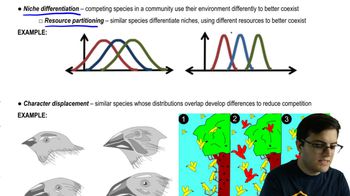
Explore niche differentiation: Niche differentiation is a process through which competing species use the environment differently in a way that helps them to coexist. This often involves the evolution of traits that reduce niche overlap and competition.
Consider the options given: Analyze each option to determine which one best describes niche differentiation. Option a suggests the evolution of traits to reduce niche overlap, which aligns with the concept of niche differentiation.
Evaluate the other options: Option b refers to species occupying their fundamental niche, which is not directly related to niche differentiation. Option c talks about the degree of niche overlap, which is a factor but not the definition of niche differentiation. Option d is about species with the same niche not coexisting, which is related to competitive exclusion rather than niche differentiation.
Conclude with the most accurate definition: Based on the analysis, option a is the most accurate description of niche differentiation, as it involves the evolution of traits to reduce competition and overlap.

Verified video answer for a similar problem:

This video solution was recommended by our tutors as helpful for the problem above.
Video duration:
51s
Was this helpful?

Key Concepts

Here are the essential concepts you must grasp in order to answer the question correctly.

Niche Differentiation

Niche differentiation refers to the process by which competing species evolve traits that allow them to utilize different resources or occupy different areas within an ecosystem, thereby reducing direct competition. This evolutionary adaptation helps species coexist by minimizing niche overlap, ensuring that each species can thrive in its own unique niche.
Recommended video:
Guided course
03:43
Competitive Exclusion and Niche Differentiation

Fundamental Niche

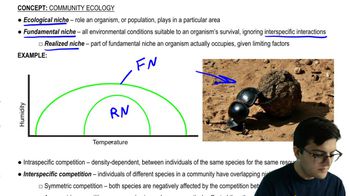
A fundamental niche encompasses the full range of environmental conditions and resources an organism can theoretically use if there are no competitors or other limiting factors. It represents the potential living space and resource usage of a species, which can be restricted by competition, predation, and other ecological interactions.
Recommended video:
Guided course
02:48
Ecological Niches and Competition

Competitive Exclusion Principle

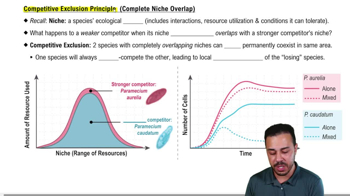
The competitive exclusion principle states that two species competing for the exact same resources cannot stably coexist. One species will outcompete the other, leading to the exclusion or extinction of the less competitive species. This principle underscores the importance of niche differentiation in allowing species to coexist by reducing direct competition.
Recommended video:
Guided course
04:23
Competitive Exclusion Principle (Complete Niche Overlap)