Ch. 38 - Flowering Plant Reproduction and Development
Freeman - Biological Science 8th Edition
Freeman8th EditionBiological ScienceISBN: 9780138276263Not the one you use?Change textbook
Chapter 38, Problem 1

Evaluate these statements about double fertilization. Select True or False for each sentence.
T/FTwo zygotes are formed, but only one survives.
T/FOne sperm fuses with an egg while the other sperm fuses with polar nuclei.
T/FIt results in the formation of a diploid embryo and triploid endosperm.
T/FBoth sperm involved in double fertilization form within the same pollen tube.

Verified step by step guidance
1
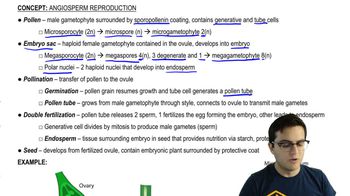
Understand the concept of double fertilization in angiosperms, which involves two sperm cells. One sperm cell fertilizes the egg cell, forming a diploid zygote, while the other sperm cell fuses with two polar nuclei to form a triploid endosperm.
Evaluate the statement 'Two zygotes are formed, but only one survives.' In double fertilization, only one zygote is formed from the fusion of one sperm with the egg cell. The other sperm cell does not form a zygote but contributes to the formation of the endosperm.
Consider the statement 'One sperm fuses with an egg while the other sperm fuses with polar nuclei.' This accurately describes the process of double fertilization, where one sperm cell fertilizes the egg and the other fuses with the polar nuclei.
Analyze the statement 'It results in the formation of a diploid embryo and triploid endosperm.' This is true, as the fertilization of the egg by one sperm results in a diploid embryo, and the fusion of the other sperm with the polar nuclei results in a triploid endosperm.
Review the statement 'Both sperm involved in double fertilization form within the same pollen tube.' This is true, as both sperm cells are delivered to the ovule through the same pollen tube during the process of fertilization.

Verified video answer for a similar problem:

This video solution was recommended by our tutors as helpful for the problem above.
Video duration:
1m
Was this helpful?

Key Concepts

Here are the essential concepts you must grasp in order to answer the question correctly.

Double Fertilization

Double fertilization is a unique process in flowering plants where two sperm cells from a pollen grain fertilize two different cells within the ovule. One sperm cell fuses with the egg cell to form a diploid zygote, while the other sperm cell fuses with two polar nuclei to form a triploid endosperm, which provides nourishment to the developing embryo.
Recommended video:
Guided course
07:44
Double Fertilization

Pollen Tube Formation

The pollen tube is a structure that forms after a pollen grain lands on the stigma of a flower. It grows down the style to reach the ovule, allowing the sperm cells to travel to the egg and polar nuclei. Both sperm cells involved in double fertilization are formed within the same pollen tube, ensuring they reach the ovule simultaneously for fertilization.
Recommended video:
Guided course
03:08
Formation & Breakdown of Polysaccharides

Zygote and Endosperm Formation

In double fertilization, the fusion of one sperm with the egg cell results in the formation of a diploid zygote, which will develop into the embryo. The fusion of the second sperm with the polar nuclei results in the formation of a triploid endosperm, which serves as a food reserve for the growing embryo, supporting its development within the seed.
Recommended video:
Guided course
03:08
Formation & Breakdown of Polysaccharides