Ch. 37 - Plant Sensory Systems, Signals, and Responses
Freeman - Biological Science 8th Edition
Freeman8th EditionBiological ScienceISBN: 9780138276263Not the one you use?Change textbook
Chapter 37, Problem 1

Evaluate the following assertions about phototropism. Select True or False for each statement.
T/F Cells on the illuminated side of a stem elongate more than cells on the shaded side.
T/F Phototropism is triggered by blue light.
T/F Phototropins play a significant role in phototropism.
T/F The bending of the plant is due to cell elongation in response to auxin.

Verified step by step guidance
1
Understand that phototropism is the growth of a plant in response to light direction, typically causing the plant to bend towards the light source.
Evaluate the first statement: In phototropism, cells on the shaded side of the stem elongate more than those on the illuminated side due to the uneven distribution of the hormone auxin, which promotes cell elongation.
Consider the second statement: Phototropism is primarily triggered by blue light, as plants have specific photoreceptors called phototropins that are sensitive to blue light.
Analyze the third statement: Phototropins are indeed significant in phototropism as they are the blue light receptors that initiate the phototropic response.
Examine the fourth statement: The bending of the plant is due to differential cell elongation, where auxin accumulates more on the shaded side, causing those cells to elongate more and the plant to bend towards the light.

Verified video answer for a similar problem:

This video solution was recommended by our tutors as helpful for the problem above.
Video duration:
33s
Was this helpful?

Key Concepts

Here are the essential concepts you must grasp in order to answer the question correctly.

Phototropism

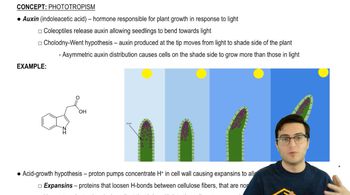
Phototropism is the growth response of a plant in direction to a light source. It is a crucial adaptive mechanism that allows plants to maximize light absorption for photosynthesis. Typically, plants exhibit positive phototropism, where they grow towards the light, which is primarily influenced by the differential growth of cells on different sides of the plant stem.
Recommended video:
Guided course
02:00
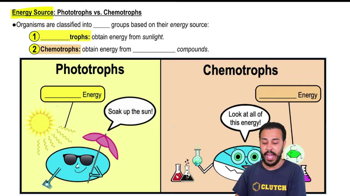
Energy Source: Phototrophs vs. Chemotrophs

Role of Blue Light and Phototropins

Blue light is a key trigger for phototropism, as it is detected by specific photoreceptors called phototropins. These proteins are sensitive to blue light and initiate a signaling cascade that results in the redistribution of growth hormones like auxin, leading to differential cell elongation and bending of the plant towards the light source.
Recommended video:
Guided course
15:15
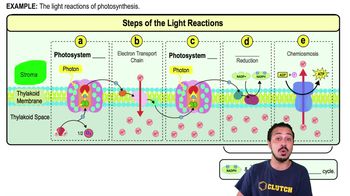
Steps of the Light Reactions

Auxin and Cell Elongation

Auxin is a plant hormone that plays a pivotal role in cell elongation during phototropism. When a plant is exposed to light, auxin is redistributed to the shaded side of the stem, causing cells there to elongate more than those on the illuminated side. This differential growth results in the bending of the plant towards the light, facilitating optimal light capture for photosynthesis.
Recommended video: