Ch. 21 - Genes, Development, and Evolution
Freeman - Biological Science 8th Edition
Freeman8th EditionBiological ScienceISBN: 9780138276263Not the one you use?Change textbook
Chapter 21, Problem 3

What is a homeotic mutant?
a. An individual with a structure located in the wrong place
b. An individual with an abnormal head-to-tail axis
c. An individual that is missing segments
d. An individual with double the normal number of structures

Verified step by step guidance
1
Understand the term 'homeotic mutant': A homeotic mutant refers to an organism in which a body part or structure develops in the wrong location due to mutations in homeotic genes, which are responsible for determining the identity of body segments during development.
Review the role of homeotic genes: These genes, such as Hox genes, are critical in specifying the identity of body regions along the anterior-posterior axis. Mutations in these genes can cause structures to form in inappropriate locations.
Analyze the options provided: a) An individual with a structure located in the wrong place, b) An individual with an abnormal head-to-tail axis, c) An individual that is missing segments, d) An individual with double the normal number of structures.
Eliminate incorrect options: Options b, c, and d describe other types of developmental abnormalities, such as axis formation defects, segmentation issues, or duplication of structures, which are not specific to homeotic mutations.
Conclude that the correct answer is option a: A homeotic mutant is characterized by a structure being located in the wrong place, which directly aligns with the definition of a homeotic mutation.

Verified video answer for a similar problem:

This video solution was recommended by our tutors as helpful for the problem above.
Video duration:
3m
Was this helpful?

Key Concepts

Here are the essential concepts you must grasp in order to answer the question correctly.

Homeotic Genes

Homeotic genes are a group of regulatory genes that control the development of anatomical structures in various organisms. They play a crucial role in determining the identity of body segments during embryonic development. Mutations in these genes can lead to the misplacement of body parts, resulting in homeotic mutants.
Recommended video:
Guided course
05:02
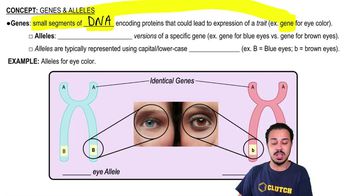
Genes & Alleles

Mutations and Developmental Biology

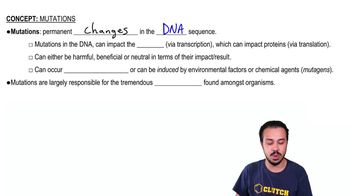
In developmental biology, mutations refer to changes in the DNA sequence that can affect an organism's development. Homeotic mutations specifically alter the normal pattern of body structure formation, leading to abnormalities such as the presence of body parts in incorrect locations, which is a hallmark of homeotic mutants.
Recommended video:

Phenotypic Expression

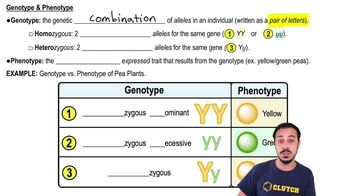
Phenotypic expression refers to the observable traits or characteristics of an organism resulting from the interaction of its genotype with the environment. In the context of homeotic mutants, the phenotypic expression manifests as structural anomalies, such as limbs or organs appearing in inappropriate locations, highlighting the impact of genetic regulation on physical form.
Recommended video:
Guided course
06:36
Genotype & Phenotype