
Ch. 1 - Biology: The Study of Life
Freeman - Biological Science 8th Edition
Freeman8th EditionBiological ScienceISBN: 9780138276263Not the one you use?Change textbook
Chapter 1, Problem 3

What does it mean to say that a characteristic is heritable?
a. The characteristic evolves.
b. The characteristic can be passed on to offspring.
c. The characteristic is advantageous to the organism.
d. The characteristic does not vary in the population.

Verified step by step guidance
1
Understand the term 'heritable': In biology, a heritable characteristic is one that can be passed from parents to their offspring through genetic information.
Consider the options given: a. The characteristic evolves, b. The characteristic can be passed on to offspring, c. The characteristic is advantageous to the organism, d. The characteristic does not vary in the population.
Evaluate option a: While evolution involves changes in heritable traits over generations, the term 'heritable' itself does not imply that a characteristic evolves.
Evaluate option b: This option directly aligns with the definition of heritability, as it refers to the ability of a characteristic to be passed on to offspring.
Evaluate options c and d: A characteristic being advantageous or not varying in the population does not necessarily relate to its heritability. Heritability is about genetic transmission, not the trait's advantage or variability.

Verified video answer for a similar problem:

This video solution was recommended by our tutors as helpful for the problem above.
Video duration:
1m
Was this helpful?

Key Concepts

Here are the essential concepts you must grasp in order to answer the question correctly.

Heritability

Heritability refers to the proportion of observed variation in a particular trait among individuals in a population that is due to genetic differences. It indicates the potential for a trait to be passed from parents to offspring through genetic inheritance. Heritability is a key concept in understanding how traits are transmitted across generations and can influence evolutionary processes.
Recommended video:
Guided course
04:52
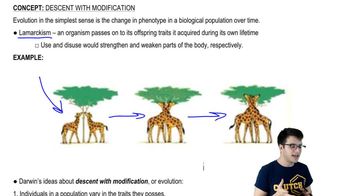
Descent With Modification

Genetic Inheritance

Genetic inheritance is the process by which genetic information is passed from parents to their offspring. This occurs through the transmission of genes, which are segments of DNA that encode specific traits. Understanding genetic inheritance is crucial for comprehending how characteristics are passed down and how they can manifest in future generations.
Recommended video:
Guided course
01:02
Autosomal Inheritance

Variation in Population

Variation in a population refers to the differences in traits among individuals within a group. This variation can be due to genetic factors, environmental influences, or a combination of both. Recognizing variation is essential for understanding evolutionary mechanisms, as it provides the raw material for natural selection to act upon, leading to adaptation and evolution.
Recommended video:
02:16
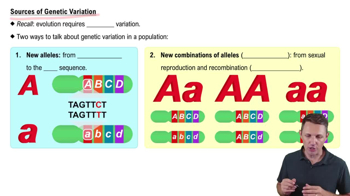
Sources of Genetic Variation