Solve each problem. (Source for Exercises 49 and 50: Parker, M., Editor, She Does Math, Mathematical Association of America.) Length of Sides of an Isosceles Triangle An isosceles triangle has a base of length 49.28 m. The angle opposite the base is 58.746°. Find the length of each of the two equal sides.
Table of contents
- 0. Review of College Algebra4h 45m
- 1. Measuring Angles40m
- 2. Trigonometric Functions on Right Triangles2h 5m
- 3. Unit Circle1h 19m
- 4. Graphing Trigonometric Functions1h 19m
- 5. Inverse Trigonometric Functions and Basic Trigonometric Equations1h 41m
- 6. Trigonometric Identities and More Equations2h 34m
- 7. Non-Right Triangles1h 38m
- 8. Vectors2h 25m
- 9. Polar Equations2h 5m
- 10. Parametric Equations1h 6m
- 11. Graphing Complex Numbers1h 7m
2. Trigonometric Functions on Right Triangles
Trigonometric Functions on Right Triangles
Problem 60
Textbook Question
Solve each problem. (Source for Exercises 49 and 50: Parker, M., Editor, She Does Math, Mathematical Association of America.)Create a right triangle problem whose solution can be found by evaluating θ if sin θ = ¾.
Verified step by step guidance1
Understand that the problem asks to create a right triangle where the angle \( \theta \) satisfies \( \sin \theta = \frac{3}{4} \). Recall that \( \sin \theta = \frac{\text{opposite side}}{\text{hypotenuse}} \) in a right triangle.
Assign the opposite side length as 3 units and the hypotenuse as 4 units, based on the sine ratio \( \sin \theta = \frac{3}{4} \).
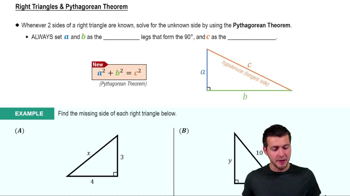
Use the Pythagorean theorem to find the length of the adjacent side: \( \text{adjacent} = \sqrt{\text{hypotenuse}^2 - \text{opposite}^2} = \sqrt{4^2 - 3^2} \).
Express the problem: "In a right triangle, the side opposite angle \( \theta \) is 3 units, and the hypotenuse is 4 units. Find \( \theta \) by evaluating \( \sin^{-1} \left( \frac{3}{4} \right) \)."
To solve for \( \theta \), use the inverse sine function: \( \theta = \sin^{-1} \left( \frac{3}{4} \right) \). This step completes the setup for finding the angle \( \theta \).
Verified video answer for a similar problem:This video solution was recommended by our tutors as helpful for the problem above
Video duration:
3mPlay a video:
0 Comments
Key Concepts
Here are the essential concepts you must grasp in order to answer the question correctly.
Right Triangle and Trigonometric Ratios
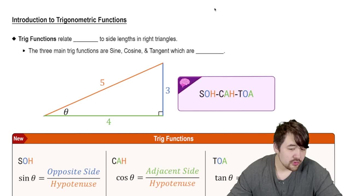
A right triangle has one 90-degree angle, and its sides relate through trigonometric ratios like sine, cosine, and tangent. The sine of an angle θ is the ratio of the length of the side opposite θ to the hypotenuse. Understanding this relationship allows solving for unknown sides or angles.
Recommended video:
Introduction to Trigonometric Functions
Inverse Sine Function (sin⁻¹ or arcsin)
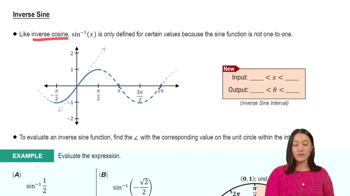
The inverse sine function is used to find the angle θ when the sine value is known. Given sin θ = 3/4, θ can be found by calculating θ = sin⁻¹(3/4). This function returns an angle in the range of -90° to 90°, which corresponds to the angle in a right triangle.
Recommended video:
Inverse Sine
Constructing a Right Triangle from a Given Ratio
To create a right triangle problem from sin θ = 3/4, assign side lengths consistent with this ratio, such as opposite side = 3 units and hypotenuse = 4 units. Using the Pythagorean theorem, the adjacent side can be found, enabling full characterization of the triangle and solving related problems.
Recommended video:
Solving Right Triangles with the Pythagorean Theorem
Related Videos
Related Practice
Textbook Question
678
views