Determine whether each statement is possible or impossible. See Example 4. sin θ = 3
Verified step by step guidance
1
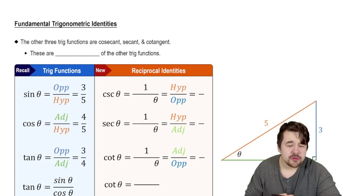
Recall that the sine function, \( \sin \theta \), represents the ratio of the opposite side to the hypotenuse in a right triangle.
The range of the sine function is between -1 and 1, inclusive. This means \( -1 \leq \sin \theta \leq 1 \).
Given the statement \( \sin \theta = 3 \), observe that 3 is outside the range of possible values for the sine function.
Since 3 is greater than 1, it is impossible for \( \sin \theta \) to equal 3.
Conclude that the statement \( \sin \theta = 3 \) is impossible based on the range of the sine function.
Verified video answer for a similar problem:
This video solution was recommended by our tutors as helpful for the problem above
Video duration:
56s
Play a video:
0 Comments
Key Concepts
Here are the essential concepts you must grasp in order to answer the question correctly.
Range of the Sine Function
The sine function, denoted as sin(θ), has a range of values between -1 and 1 for all real angles θ. This means that the output of the sine function cannot exceed these bounds. Therefore, any statement claiming that sin(θ) equals a value outside this range, such as 3, is impossible.
Trigonometric identities are equations involving trigonometric functions that hold true for all values of the variables involved. Understanding these identities helps in manipulating and solving trigonometric equations. In this case, recognizing that sin(θ) cannot equal 3 is a fundamental aspect of using these identities effectively.
In trigonometry, angles can be measured in degrees or radians, and each angle corresponds to a specific value of sine, cosine, and tangent. Knowing how these functions behave for different angles is crucial. Since sin(θ) is defined for all angles but constrained to the range of -1 to 1, it is essential to understand that certain values are unattainable.