Determine whether each statement is possible or impossible. See Example 4. cot θ = ―6
Ch. 1 - Trigonometric Functions
Chapter 2, Problem 67
Use identities to solve each of the following. Rationalize denominators when applicable. See Examples 5–7. Find csc θ , given that cot θ = ―1/2 and θ is in quadrant IV.
Verified step by step guidance1
Recall the definitions of the trigonometric functions involved: \( \cot \theta = \frac{\cos \theta}{\sin \theta} \) and \( \csc \theta = \frac{1}{\sin \theta} \). Since \( \cot \theta = -\frac{1}{2} \), we can write \( \frac{\cos \theta}{\sin \theta} = -\frac{1}{2} \).
Express \( \cos \theta \) in terms of \( \sin \theta \) using the given cotangent: \( \cos \theta = -\frac{1}{2} \sin \theta \).
Use the Pythagorean identity \( \sin^2 \theta + \cos^2 \theta = 1 \) to substitute \( \cos \theta \) and solve for \( \sin \theta \). This gives: \( \sin^2 \theta + \left(-\frac{1}{2} \sin \theta\right)^2 = 1 \).
Simplify the equation to find \( \sin^2 \theta \), then take the square root to find \( \sin \theta \). Remember to consider the sign of \( \sin \theta \) based on the quadrant: since \( \theta \) is in quadrant IV, \( \sin \theta \) is negative.
Finally, find \( \csc \theta = \frac{1}{\sin \theta} \) and rationalize the denominator if necessary to express the answer in simplest form.

Verified video answer for a similar problem:
This video solution was recommended by our tutors as helpful for the problem above.
Video duration:
3mWas this helpful?
Key Concepts
Here are the essential concepts you must grasp in order to answer the question correctly.
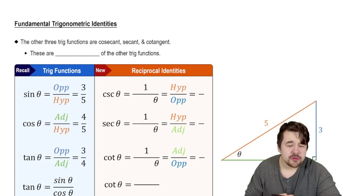
Trigonometric Identities
Trigonometric identities are equations involving trigonometric functions that hold true for all values of the variable where both sides are defined. Key identities like cot²θ + 1 = csc²θ allow us to relate cotangent and cosecant, enabling the calculation of one function given the other.
Recommended video:
Fundamental Trigonometric Identities
Sign of Trigonometric Functions in Quadrants
The sign of trigonometric functions depends on the quadrant in which the angle lies. In quadrant IV, sine and cosecant are negative, while cosine and secant are positive. This information is crucial to determine the correct sign of the solution when using identities.
Recommended video:
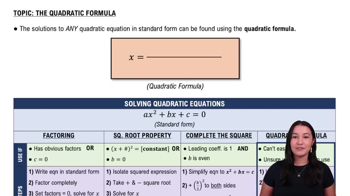
Quadratic Formula
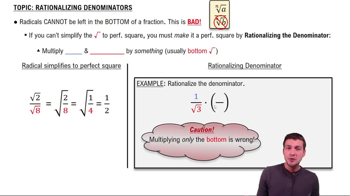
Rationalizing Denominators
Rationalizing denominators involves eliminating radicals or complex expressions from the denominator of a fraction. This process simplifies the expression and is often required for final answers in trigonometry problems to maintain standard form.
Recommended video:
Rationalizing Denominators
Related Practice
Textbook Question
917
views
Textbook Question
Convert each angle measure to degrees, minutes, and seconds. If applicable, round to the nearest second. See Example 4(b). 174.255°
629
views
Textbook Question
In each figure, there are two similar triangles. Find the unknown measurement. Give approximations to the nearest tenth.
664
views
Textbook Question
Find the indicated function value. If it is undefined, say so. See Example 4. sin 90°
670
views
Textbook Question
Find the indicated function value. If it is undefined, say so. See Example 4. sec 180°
707
views
Textbook Question
Solve each problem. See Example 5. Height of a Carving of Lincoln Assume that Lincoln was 6 1/3 ft tall and his head was 3/4 ft long. Knowing that the carved head of Lincoln at Mt. Rushmore is 60 ft tall, find how tall his entire body would be if it were carved into the mountain.
734
views