Determine whether each statement is possible or impossible. See Example 4. csc θ = 100
Verified step by step guidance
1
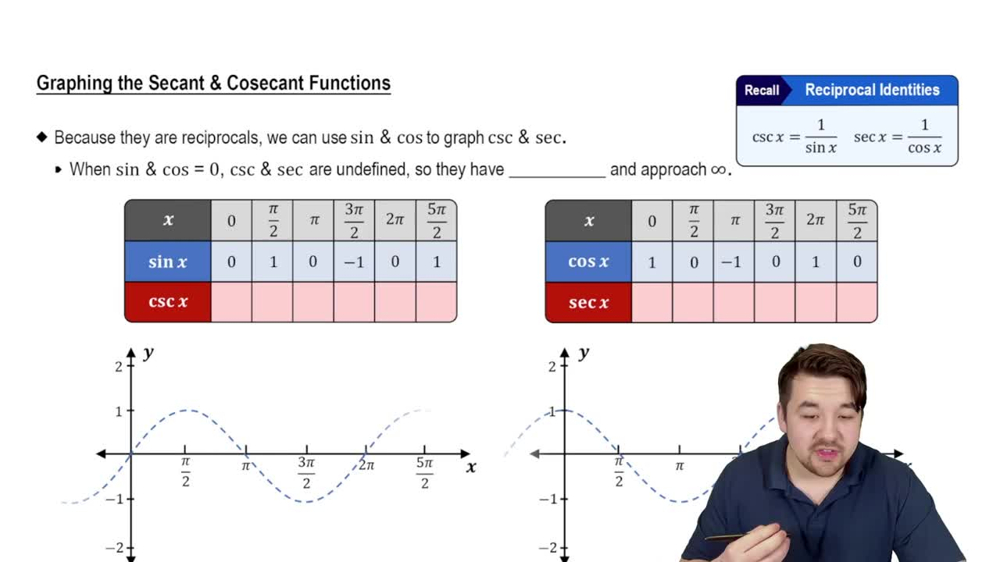
Recall the definition of the cosecant function: \(\csc \theta = \frac{1}{\sin \theta}\).
Since \(\csc \theta = 100\), this means \(\sin \theta = \frac{1}{100} = 0.01\).
Consider the range of the sine function: \(-1 \leq \sin \theta \leq 1\). Since \(0.01\) lies within this range, it is a valid sine value.
Therefore, it is possible for \(\csc \theta\) to equal 100 because \(\sin \theta\) can be \(0.01\).
To find the specific angle(s) \(\theta\), you would use the inverse sine function: \(\theta = \sin^{-1}(0.01)\), keeping in mind the periodicity and symmetry of the sine function.
Verified video answer for a similar problem:
This video solution was recommended by our tutors as helpful for the problem above
Video duration:
53s
Play a video:
0 Comments
Key Concepts
Here are the essential concepts you must grasp in order to answer the question correctly.
Definition and Range of Cosecant Function
The cosecant function, csc θ, is the reciprocal of the sine function, defined as csc θ = 1/sin θ. Since sine values range between -1 and 1, the cosecant values must be either greater than or equal to 1 or less than or equal to -1, never between -1 and 1.
Trigonometric functions have specific ranges that determine which values are possible. For csc θ, values like 100 are possible because they are greater than 1, meaning there exists an angle θ where sin θ = 1/100, which is within the sine function's range.
Since csc θ = 1/sin θ, understanding the reciprocal relationship helps in determining the feasibility of a given csc value. If csc θ = 100, then sin θ = 1/100, a small but valid sine value, confirming the statement is possible.

 0:53 minutes
 Verified step by step guidance
 6:22
6:22