Plot each complex number. Then write the complex number in polar form. You may express the argument in degrees or radians. 2 + 2i
Table of contents
- 0. Review of College Algebra4h 45m
- 1. Measuring Angles40m
- 2. Trigonometric Functions on Right Triangles2h 5m
- 3. Unit Circle1h 19m
- 4. Graphing Trigonometric Functions1h 19m
- 5. Inverse Trigonometric Functions and Basic Trigonometric Equations1h 41m
- 6. Trigonometric Identities and More Equations2h 34m
- 7. Non-Right Triangles1h 38m
- 8. Vectors2h 25m
- 9. Polar Equations2h 5m
- 10. Parametric Equations1h 6m
- 11. Graphing Complex Numbers1h 7m
11. Graphing Complex Numbers
Polar Form of Complex Numbers
Problem 27
Textbook Question
In Exercises 27–36, write each complex number in rectangular form. If necessary, round to the nearest tenth. 6(cos 30° + i sin 30°)
Verified step by step guidance1
Recognize that the given complex number is in polar (trigonometric) form: \(r(\cos \theta + i \sin \theta)\), where \(r = 6\) and \(\theta = 30^\circ\).
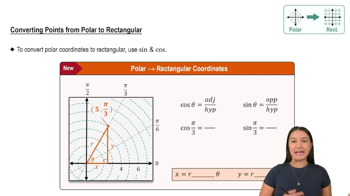
Recall that to convert from polar form to rectangular form, use the formulas: \(x = r \cos \theta\) and \(y = r \sin \theta\), where \(x\) is the real part and \(y\) is the imaginary part.
Calculate the real part: \(x = 6 \times \cos 30^\circ\).
Calculate the imaginary part: \(y = 6 \times \sin 30^\circ\).
Write the rectangular form as \(x + yi\), substituting the values found for \(x\) and \(y\). If necessary, round the values to the nearest tenth.
Verified video answer for a similar problem:This video solution was recommended by our tutors as helpful for the problem above
Video duration:
3mPlay a video:
0 Comments
Key Concepts
Here are the essential concepts you must grasp in order to answer the question correctly.
Polar Form of Complex Numbers
A complex number can be expressed in polar form as r(cos θ + i sin θ), where r is the magnitude (modulus) and θ is the argument (angle). This form highlights the geometric interpretation of complex numbers on the complex plane.
Recommended video:
Complex Numbers In Polar Form
Conversion from Polar to Rectangular Form
To convert a complex number from polar to rectangular form, use the formulas x = r cos θ and y = r sin θ, where x is the real part and y is the imaginary part. This allows expressing the number as x + iy.
Recommended video:
Converting Complex Numbers from Polar to Rectangular Form
Trigonometric Values and Rounding
Evaluating cos θ and sin θ for specific angles often requires using exact values or approximations. When the problem asks for rounding, calculate the decimal values and round to the nearest tenth to express the rectangular form accurately.
Recommended video:
Fundamental Trigonometric Identities
Related Videos
Related Practice
Textbook Question
436
views