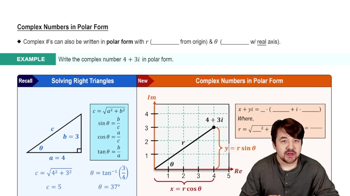
Plot each complex number. Then write the complex number in polar form. You may express the argument in degrees or radians. 2 + 2i
Verified step by step guidance
1
Identify the complex number given: \$2 + 2i$, where the real part is 2 and the imaginary part is 2.
Plot the complex number on the complex plane by marking the point at coordinates \((2, 2)\), where the x-axis represents the real part and the y-axis represents the imaginary part.
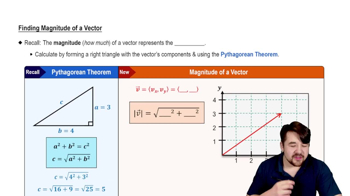
Calculate the modulus (or magnitude) \(r\) of the complex number using the formula \(r = \sqrt{(\text{real part})^2 + (\text{imaginary part})^2} = \sqrt{2^2 + 2^2}\).
Find the argument (or angle) \(\theta\) of the complex number using \(\theta = \tan^{-1}\left(\frac{\text{imaginary part}}{\text{real part}}\right) = \tan^{-1}\left(\frac{2}{2}\right)\), which can be expressed in degrees or radians.
Write the complex number in polar form as \(r(\cos \theta + i \sin \theta)\) or equivalently \(r \operatorname{cis} \theta\), using the values of \(r\) and \(\theta\) calculated in the previous steps.
Verified video answer for a similar problem:
This video solution was recommended by our tutors as helpful for the problem above
Video duration:
2m
Play a video:
0 Comments
Key Concepts
Here are the essential concepts you must grasp in order to answer the question correctly.
Complex Numbers and the Complex Plane
A complex number is expressed as a + bi, where a is the real part and b is the imaginary part. It can be represented as a point or vector in the complex plane, with the x-axis as the real axis and the y-axis as the imaginary axis. Plotting involves locating the point (a, b) on this plane.
Polar form expresses a complex number using its magnitude (distance from origin) and argument (angle with the positive real axis). It is written as r(cos θ + i sin θ) or r∠θ, where r = √(a² + b²) and θ = arctangent(b/a). This form highlights the number's geometric properties.
The magnitude r is the length of the vector from the origin to the point (a, b), calculated by r = √(a² + b²). The argument θ is the angle formed with the positive real axis, found using θ = arctan(b/a), adjusted for the correct quadrant. These values convert rectangular form to polar form.

 2:43 minutes
 Verified step by step guidance
 4:22
4:22