In Exercises 11–26, plot each complex number. Then write the complex number in polar form. You may express the argument in degrees or radians. −3
Verified step by step guidance
1
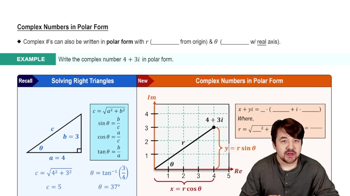
Identify the complex number given, which is \(-3 + 0i\). This means the complex number lies on the real axis at \(-3\).
Plot the point on the complex plane: since the imaginary part is zero, plot the point at \(-3\) on the real axis.
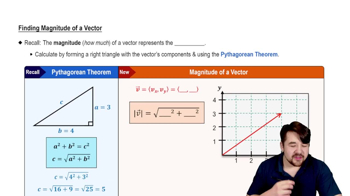
Calculate the modulus (or magnitude) \(r\) of the complex number using the formula \(r = \sqrt{x^2 + y^2}\), where \(x = -3\) and \(y = 0\).
Determine the argument \(\theta\), which is the angle the line from the origin to the point makes with the positive real axis. Since the point is on the negative real axis, \(\theta\) is either \(\pi\) radians or \(180^\circ\).
Write the complex number in polar form as \(r(\cos \theta + i \sin \theta)\) or \(r \operatorname{cis} \theta\), substituting the values of \(r\) and \(\theta\) found in the previous steps.
Verified video answer for a similar problem:
This video solution was recommended by our tutors as helpful for the problem above
Video duration:
3m
Play a video:
0 Comments
Key Concepts
Here are the essential concepts you must grasp in order to answer the question correctly.
Complex Numbers and the Complex Plane
A complex number is expressed as a + bi, where a is the real part and b is the imaginary part. Plotting a complex number involves representing it as a point or vector in the complex plane, with the x-axis as the real axis and the y-axis as the imaginary axis.
The polar form represents a complex number using its magnitude (distance from the origin) and argument (angle with the positive real axis). It is written as r(cos θ + i sin θ) or r∠θ, where r is the modulus and θ is the argument in degrees or radians.
The magnitude r of a complex number a + bi is found using r = √(a² + b²). The argument θ is the angle formed with the positive real axis, calculated using θ = arctan(b/a), adjusted for the correct quadrant. These values are essential for converting to polar form.

 3:31 minutes
 Verified step by step guidance
 4:22
4:22