Ch. 5 - Complex Numbers, Polar Coordinates and Parametric Equations
Blitzer - Trigonometry 3rd Edition
Blitzer3rd EditionTrigonometryISBN: 9780137316601Not the one you use?Change textbook
Chapter 5, Problem 79

In Exercises 77–80, convert to polar form and then perform the indicated operations. Express answers in polar and rectangular form.
(1 + i√3)(1 − i)) / 2√3 − 2i

Verified step by step guidance
1
Identify the complex numbers involved in the expression: \( (1 + i\sqrt{3}) \), \( (1 - i) \), and the denominator \( 2\sqrt{3} - 2i \).
Convert each complex number to polar form by finding their magnitudes and arguments. For a complex number \( z = a + bi \), magnitude is \( r = \sqrt{a^2 + b^2} \) and argument is \( \theta = \tan^{-1}(b/a) \).
Express each complex number in polar form as \( r(\cos \theta + i \sin \theta) \) or equivalently \( r e^{i\theta} \).
Perform the multiplication and division in polar form by multiplying/dividing the magnitudes and adding/subtracting the arguments: \( r_1 e^{i\theta_1} \times r_2 e^{i\theta_2} = (r_1 r_2) e^{i(\theta_1 + \theta_2)} \) and \( \frac{r_1 e^{i\theta_1}}{r_2 e^{i\theta_2}} = \frac{r_1}{r_2} e^{i(\theta_1 - \theta_2)} \).
Convert the resulting polar form back to rectangular form using \( a = r \cos \theta \) and \( b = r \sin \theta \) to express the final answer in both polar and rectangular forms.

Verified video answer for a similar problem:

This video solution was recommended by our tutors as helpful for the problem above.
Video duration:
16m
Was this helpful?

Key Concepts

Here are the essential concepts you must grasp in order to answer the question correctly.

Complex Numbers in Rectangular and Polar Form

Complex numbers can be expressed in rectangular form as a + bi, where a is the real part and b is the imaginary part. In polar form, they are represented as r(cos θ + i sin θ) or r∠θ, where r is the magnitude and θ is the argument (angle). Converting between these forms is essential for simplifying multiplication and division.
Recommended video:
03:58
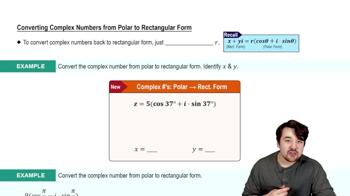
Converting Complex Numbers from Polar to Rectangular Form

Conversion Between Rectangular and Polar Coordinates

To convert from rectangular to polar form, calculate the magnitude r = √(a² + b²) and the argument θ = arctan(b/a). Conversely, to convert from polar to rectangular form, use a = r cos θ and b = r sin θ. Accurate conversion is crucial for performing operations and expressing final answers in both forms.
Recommended video:
06:17
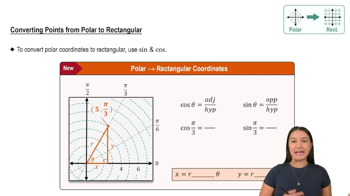
Convert Points from Polar to Rectangular

Operations on Complex Numbers in Polar Form

Multiplication and division of complex numbers are simpler in polar form: multiply/divide their magnitudes and add/subtract their angles. For example, (r₁∠θ₁)(r₂∠θ₂) = (r₁r₂)∠(θ₁ + θ₂). This property streamlines calculations compared to rectangular form, especially for products and quotients.
Recommended video:
04:47
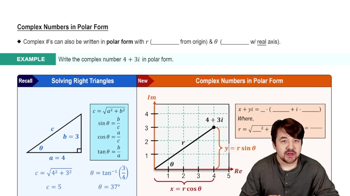
Complex Numbers In Polar Form