Write each function in terms of its cofunction. Assume all angles involved are acute angles. See Example 2. sin 45°
Verified step by step guidance
1
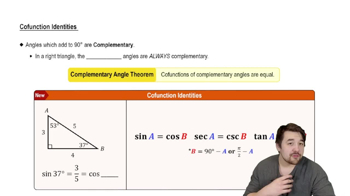
Recall the cofunction identity for sine and cosine: \(\sin(\theta) = \cos(90^\circ - \theta)\) for acute angles.
Identify the given angle \(\theta = 45^\circ\).
Apply the cofunction identity by substituting \(\theta\) with \(45^\circ\): \(\sin(45^\circ) = \cos(90^\circ - 45^\circ)\).
Simplify the expression inside the cosine function: \(90^\circ - 45^\circ = 45^\circ\).
Write the final expression: \(\sin(45^\circ) = \cos(45^\circ)\).
Verified video answer for a similar problem:
This video solution was recommended by our tutors as helpful for the problem above
Video duration:
1m
Play a video:
0 Comments
Key Concepts
Here are the essential concepts you must grasp in order to answer the question correctly.
Trigonometric Functions
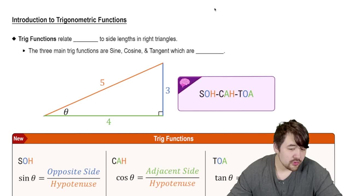
Trigonometric functions like sine, cosine, tangent, and their reciprocals relate the angles of a right triangle to the ratios of its sides. Understanding these functions is essential for expressing one function in terms of another, especially when dealing with complementary angles.
Cofunction identities state that the value of a trigonometric function of an angle equals the value of its cofunction at the complement of that angle. For example, sin(θ) = cos(90° - θ) for acute angles, which allows rewriting functions in terms of their cofunctions.
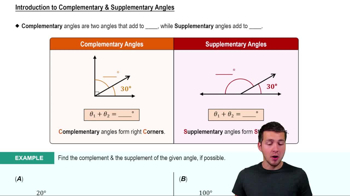
Complementary angles are two angles whose measures add up to 90°. In trigonometry, many identities and relationships, including cofunction identities, rely on this concept to connect functions of one angle to functions of its complement.