Determine whether each function is even, odd, or neither. See Example 5.ƒ(x) = -x³ + 2x
Verified step by step guidance
1
Step 1: Recall the definitions of even and odd functions. A function \( f(x) \) is even if \( f(-x) = f(x) \) for all \( x \), and it is odd if \( f(-x) = -f(x) \) for all \( x \).
Step 2: Substitute \( -x \) into the function \( f(x) = -x^3 + 2x \) to find \( f(-x) \).
Step 3: Calculate \( f(-x) = -(-x)^3 + 2(-x) \). Simplify this expression to see if it equals \( f(x) \) or \( -f(x) \).
Step 4: Simplify \( f(-x) = x^3 - 2x \). Compare this result with \( f(x) = -x^3 + 2x \) and \( -f(x) = x^3 - 2x \).
Step 5: Determine if \( f(-x) = f(x) \) or \( f(-x) = -f(x) \) to conclude whether the function is even, odd, or neither.
Verified video answer for a similar problem:
This video solution was recommended by our tutors as helpful for the problem above
Video duration:
4m
Play a video:
0 Comments
Key Concepts
Here are the essential concepts you must grasp in order to answer the question correctly.
Even and Odd Functions
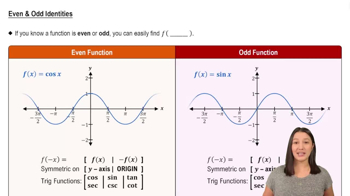
Even functions are symmetric about the y-axis, meaning that f(x) = f(-x) for all x in the domain. Odd functions, on the other hand, are symmetric about the origin, satisfying the condition f(-x) = -f(x). Understanding these definitions is crucial for determining the nature of a given function.
Polynomial functions are expressions that involve variables raised to whole number powers, combined using addition, subtraction, and multiplication. The degree of the polynomial, which is the highest power of the variable, influences its behavior and symmetry. In this case, the function f(x) = -x³ + 2x is a polynomial of degree 3.
To test if a function is even or odd, substitute -x into the function and simplify. If the result equals the original function, it is even; if it equals the negative of the original function, it is odd. If neither condition is met, the function is classified as neither even nor odd, which is essential for analyzing the given function.