Determine whether each function is even, odd, or neither. See Example 5.ƒ(x) = x³ - x + 9
Verified step by step guidance
1
To determine if a function is even, odd, or neither, we need to evaluate the function at \( -x \) and compare it to \( f(x) \).
Calculate \( f(-x) \) by substituting \( -x \) into the function: \( f(-x) = (-x)^3 - (-x) + 9 \).
Simplify \( f(-x) \): \((-x)^3 = -x^3\) and \(-(-x) = x\), so \( f(-x) = -x^3 + x + 9 \).
Compare \( f(-x) \) with \( f(x) \): \( f(x) = x^3 - x + 9 \) and \( f(-x) = -x^3 + x + 9 \).
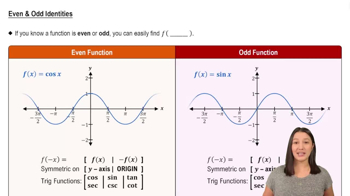
A function is even if \( f(-x) = f(x) \), odd if \( f(-x) = -f(x) \), and neither if it doesn't satisfy either condition. Compare the expressions to determine the nature of the function.
Verified video answer for a similar problem:
This video solution was recommended by our tutors as helpful for the problem above
Video duration:
3m
Play a video:
0 Comments
Key Concepts
Here are the essential concepts you must grasp in order to answer the question correctly.
Even Functions
An even function is defined by the property that f(-x) = f(x) for all x in its domain. This means that the graph of the function is symmetric with respect to the y-axis. A common example of an even function is f(x) = x², where substituting -x yields the same output as substituting x.
An odd function satisfies the condition f(-x) = -f(x) for all x in its domain. This indicates that the graph of the function is symmetric with respect to the origin. A classic example of an odd function is f(x) = x³, where substituting -x results in the negative of the output for x.
To determine if a function is even, odd, or neither, one can evaluate f(-x) and compare it to f(x) and -f(x). If f(-x) equals f(x), the function is even; if f(-x) equals -f(x), it is odd. If neither condition holds, the function is classified as neither even nor odd.