Concept Check Plot each point, and then plot the points that are symmetric to the given point with point with respect to the (b) y-axis.(-4, -2)
Verified step by step guidance
1
Plot the given point \((-4, -2)\) on the Cartesian coordinate system.
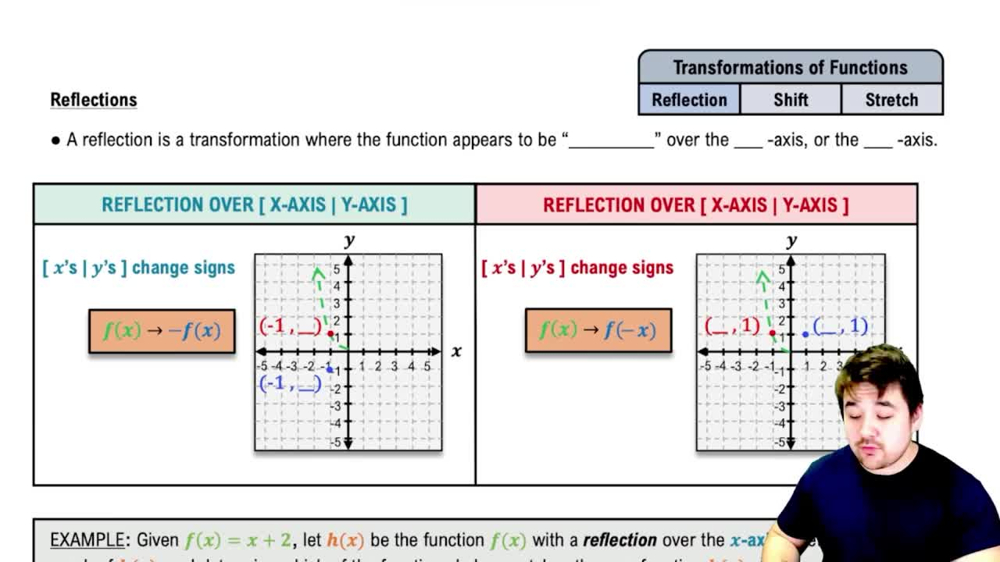
To find the point symmetric to \((-4, -2)\) with respect to the y-axis, reflect the point across the y-axis.
The x-coordinate of the symmetric point will be the opposite of the original x-coordinate, while the y-coordinate remains the same.
Change the x-coordinate from \(-4\) to \(4\), keeping the y-coordinate as \(-2\).
Plot the new point \((4, -2)\) on the Cartesian coordinate system to complete the reflection.
Verified video answer for a similar problem:
This video solution was recommended by our tutors as helpful for the problem above
Play a video:
0 Comments
Key Concepts
Here are the essential concepts you must grasp in order to answer the question correctly.
Symmetry with respect to the y-axis
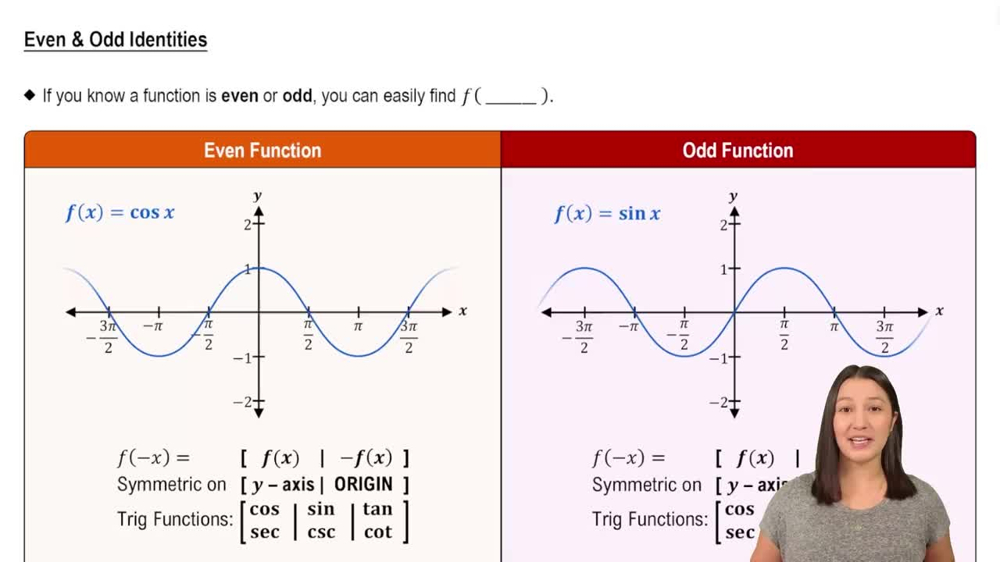
Symmetry with respect to the y-axis means that for any point (x, y), its symmetric counterpart is found at (-x, y). This reflects the point across the y-axis, maintaining the same distance from the axis but on the opposite side. Understanding this concept is crucial for accurately plotting points and their symmetric counterparts.
The coordinate plane is a two-dimensional surface defined by a horizontal axis (x-axis) and a vertical axis (y-axis). Each point on this plane is represented by an ordered pair (x, y), where 'x' indicates the horizontal position and 'y' indicates the vertical position. Familiarity with the coordinate plane is essential for visualizing and plotting points.
Plotting points involves marking a specific location on the coordinate plane based on its coordinates. For example, the point (-4, -2) is located four units left of the origin and two units down. This skill is fundamental in trigonometry and geometry, as it allows for the visualization of relationships between points, lines, and shapes.