In Exercises 54–60, convert each polar equation to a rectangular equation. Then use your knowledge of the rectangular equation to graph the polar equation in a polar coordinate system.θ = 3π/4
Verified step by step guidance
1
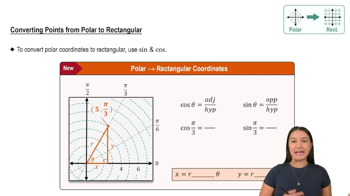
Start by recalling the relationship between polar and rectangular coordinates: \( x = r \cos \theta \) and \( y = r \sin \theta \).
Since the given equation is \( \theta = \frac{3\pi}{4} \), this represents a line where the angle \( \theta \) is constant.
In polar coordinates, \( \theta = \frac{3\pi}{4} \) corresponds to a line that passes through the origin and makes an angle of \( \frac{3\pi}{4} \) radians with the positive x-axis.
To convert this to a rectangular equation, use the tangent function: \( \tan \theta = \frac{y}{x} \). Substitute \( \theta = \frac{3\pi}{4} \) to get \( \tan \frac{3\pi}{4} = \frac{y}{x} \).
Calculate \( \tan \frac{3\pi}{4} \), which is \(-1\), and set up the equation \( \frac{y}{x} = -1 \). This simplifies to the rectangular equation \( y = -x \).
Verified video answer for a similar problem:
This video solution was recommended by our tutors as helpful for the problem above
Video duration:
2m
Play a video:
0 Comments
Key Concepts
Here are the essential concepts you must grasp in order to answer the question correctly.
Polar Coordinates
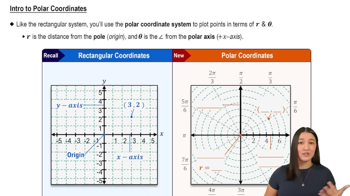
Polar coordinates represent points in a plane using a distance from a reference point (the origin) and an angle from a reference direction (usually the positive x-axis). In this system, a point is defined by the coordinates (r, θ), where 'r' is the radial distance and 'θ' is the angle. Understanding polar coordinates is essential for converting polar equations to rectangular form.
Rectangular coordinates, also known as Cartesian coordinates, represent points in a plane using two perpendicular axes (x and y). The relationship between polar and rectangular coordinates is given by the equations x = r cos(θ) and y = r sin(θ). Converting polar equations to rectangular form involves using these relationships to express the equation in terms of x and y.
Graphing polar equations involves plotting points based on their polar coordinates and understanding how these points relate to the rectangular coordinate system. The angle θ determines the direction from the origin, while the distance r determines how far from the origin the point lies. Familiarity with the shapes and behaviors of polar graphs, such as circles and spirals, is crucial for accurately representing the polar equation visually.