In Exercises 49–58, convert each rectangular equation to a polar equation that expresses r in terms of θ. x = 7
Verified step by step guidance
1
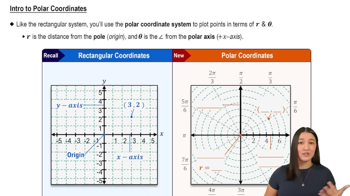
Recall the relationship between rectangular coordinates \((x, y)\) and polar coordinates \((r, \theta)\): \(x = r \cos{\theta}\) and \(y = r \sin{\theta}\).
Given the rectangular equation \(x = 7\), substitute \(x\) with \(r \cos{\theta}\) to get \(r \cos{\theta} = 7\).
To express \(r\) in terms of \(\theta\), isolate \(r\) by dividing both sides of the equation by \(\cos{\theta}\), resulting in \(r = \frac{7}{\cos{\theta}}\).
Recognize that \(\frac{1}{\cos{\theta}}\) is the secant function, so the polar equation can also be written as \(r = 7 \sec{\theta}\).
This polar equation expresses \(r\) explicitly in terms of \(\theta\), completing the conversion from rectangular to polar form.
Verified video answer for a similar problem:
This video solution was recommended by our tutors as helpful for the problem above
Video duration:
2m
Play a video:
0 Comments
Key Concepts
Here are the essential concepts you must grasp in order to answer the question correctly.
Rectangular and Polar Coordinate Systems
Rectangular coordinates represent points using (x, y) values on a Cartesian plane, while polar coordinates use (r, θ), where r is the distance from the origin and θ is the angle from the positive x-axis. Understanding the relationship between these systems is essential for converting equations.
The key formulas for conversion are x = r cos(θ) and y = r sin(θ). To convert from rectangular to polar, express x and y in terms of r and θ, then manipulate the equation to isolate r as a function of θ.
After substituting x = r cos(θ) into the given equation, solve for r to express it explicitly as a function of θ. This step is crucial to rewrite the rectangular equation in polar form, enabling analysis or graphing in polar coordinates.