Textbook Question
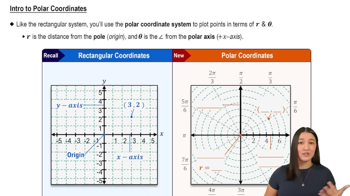
In Exercises 41–48, the rectangular coordinates of a point are given. Find polar coordinates of each point. Express θ in radians. (−√3,−1)
581
views

 Blitzer 3rd EditionCh. 5 - Complex Numbers, Polar Coordinates and Parametric EquationsProblem 5.3.53
 Verified step by step guidance
 05:32
05:32 05:32
05:32 6:36
6:36In Exercises 41–48, the rectangular coordinates of a point are given. Find polar coordinates of each point. Express θ in radians. (−√3,−1)
In Exercises 37–52, perform the indicated operations and write the result in standard form.
( −6 − √(−12)) / 48
Convert each rectangular equation to a polar equation that expresses r in terms of θ.
y = 3
Evaluate x² − 2x + 2 for x = 1 + i.
In Exercises 53–64, use DeMoivre's Theorem to find the indicated power of the complex number. Write answers in rectangular form. (√3 − i)⁶
In Exercises 1–10, plot each complex number and find its absolute value. z = 3 + 2i