Back
Back17. Periodic Motion
Energy in Pendulums
- Multiple Choice
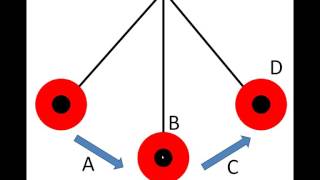
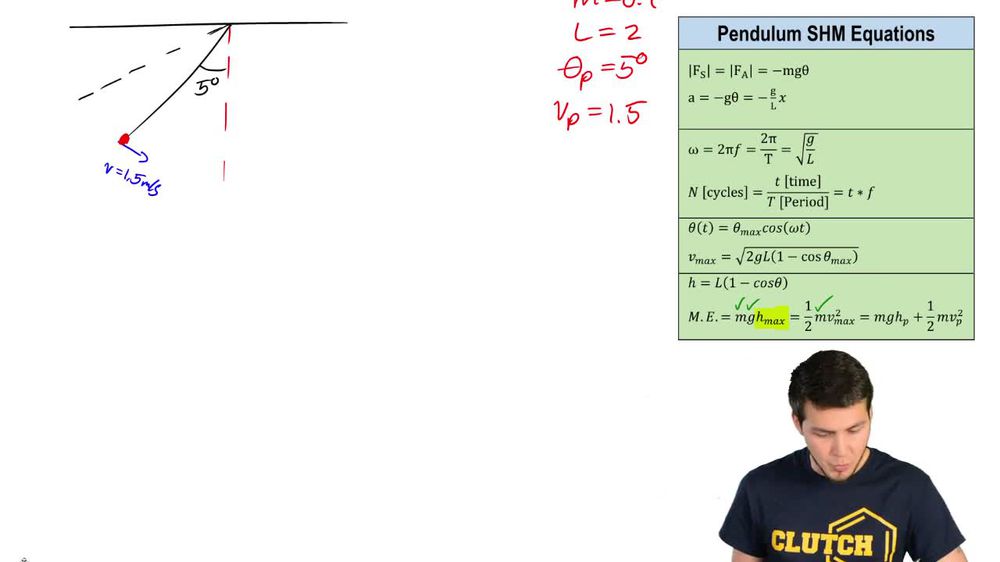
Which type of energy is primarily demonstrated by a swinging pendulum at its highest point?
789views - Textbook Question
(III) A glider on an air track is connected by springs to either end of the track (Fig. 14–41). Both springs have the same spring constant, k, and the glider has mass M.(k = 125 N/m and M = 215 g). How long does it take the amplitude to decrease to one-quarter of its initial value?
779views - Multiple Choice
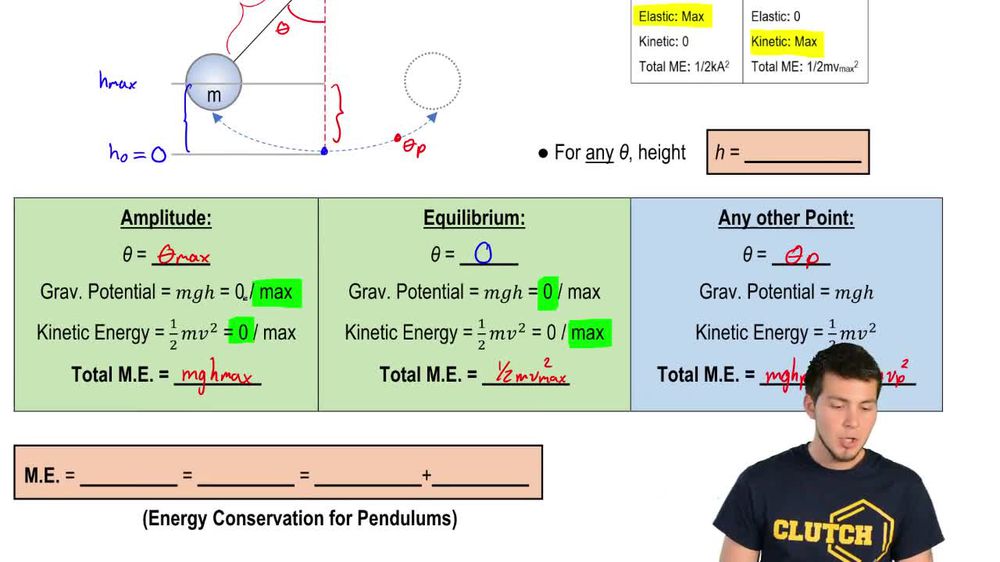
At the equilibrium position of a pendulum, which form of energy is at a maximum?
66views - Textbook Question
(III) By direct substitution, show that Eq. 14–22, with Eqs. 14–23 and 14–24, is a solution of the equation of motion (Eq. 14–21) for the forced oscillator. [Hint: To find sin ∅ and cos ∅ from tan ∅, draw a right triangle.]
1082views - Textbook Question
(III) A glider on an air track is connected by springs to either end of the track (Fig. 14–41). Both springs have the same spring constant, k, and the glider has mass M. ( k = 125 N/m and M = 215 g). It is observed that after 68 oscillations, the amplitude of the oscillation has dropped to one-half of its initial value. Estimate the value of γ, using Eq. 14–16.
79views - Textbook Question
An 1150-kg automobile has springs with k = 14,000 N/m. One of the tires is not properly balanced; it has a little extra mass on one side compared to the other, causing the car to shake at certain speeds. If the tire radius is 42 cm, at what speed will the wheel shake most?
1275views - Textbook Question
An energy-absorbing car bumper has a spring constant of 410 kN/m. Find the maximum compression of the bumper if the car, with mass 1300 kg, collides with a wall at a speed of 2.0 m/s (approximately 5 mi/h).
1244views - Textbook Question
(II) A vertical spring of spring constant 115 N/m supports a mass of 58 g. The mass oscillates in a tube of liquid. If the mass is initially given an amplitude of 5.0 cm, the mass is observed to have an amplitude of 2.0 cm after 3.5 s. Estimate the damping constant b. Neglect buoyant forces.
1139views
 09:18
09:18