
Ch. 11 - Innate Immunity
Norman-McKay- Microbiology: Basic and Clinical Principles 2nd Edition
Norman-McKay2nd EditionMicrobiology: Basic and Clinical PrinciplesISBN: 9780137661619Not the one you use?Change textbook
Chapter 11, Problem 20

Select all the false statements about fever.
a. It is generated by pyrogens
b. It is an innate immune defense
c. It is accompanied by a decrease in metabolism
d. It can be reduced by anti-inflammatory drugs
e. It can accompany inflammation

Verified step by step guidance
1
Step 1: Understand the definition of fever and its physiological basis. Fever is an elevation of the body's set-point temperature regulated by the hypothalamus, often in response to infection or inflammation.
Step 2: Analyze statement (a): 'It is generated by pyrogens.' Pyrogens are substances, often produced by pathogens or immune cells, that trigger fever by signaling the hypothalamus to raise body temperature. This statement is true.
Step 3: Analyze statement (b): 'It is an innate immune defense.' Fever is part of the innate immune response because it helps inhibit pathogen growth and enhances immune function. This statement is true.
Step 4: Analyze statement (c): 'It is accompanied by a decrease in metabolism.' Fever actually increases metabolic rate to generate heat and raise body temperature, so this statement is false.
Step 5: Analyze statements (d) and (e): 'It can be reduced by anti-inflammatory drugs' and 'It can accompany inflammation.' Both are true because anti-inflammatory drugs like NSAIDs reduce fever by inhibiting prostaglandin synthesis, and fever often occurs alongside inflammation.

Verified video answer for a similar problem:

This video solution was recommended by our tutors as helpful for the problem above.
Video duration:
2m
Was this helpful?

Key Concepts

Here are the essential concepts you must grasp in order to answer the question correctly.

Fever and Pyrogens

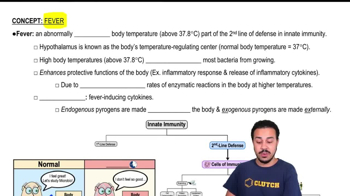
Fever is an elevation of body temperature caused by pyrogens, which are substances that trigger the hypothalamus to raise the body's set point. Pyrogens can be endogenous (produced by the body) or exogenous (from pathogens). This process helps the immune system fight infections.
Recommended video:

Metabolic Changes During Fever

Fever typically increases metabolism as the body generates more heat to raise its temperature. This heightened metabolic rate supports immune functions and accelerates repair processes, contrary to a decrease in metabolism.
Recommended video:

Fever as an Innate Immune Response and Its Modulation

Fever is part of the innate immune defense, helping to inhibit pathogen growth and enhance immune activity. It often accompanies inflammation and can be reduced by anti-inflammatory drugs, which lower the production or effect of pyrogens.
Recommended video:
Guided course
02:30
Introduction to Innate Immunity