Textbook Question
The partial amino acid sequence of a wild-type protein is
… Arg-Met-Tyr-Thr-Leu-Cys-Ser …
The same portion of the protein from a mutant has the sequence
… Arg-Met-Leu-Tyr-Ala-Leu-Phe …
Identify the type of mutation.
715
views

 Sanders 3rd EditionCh. 11 - Gene Mutation, DNA Repair, and Homologous RecombinationProblem 18
 Verified step by step guidance
 06:10
06:10
 08:41
08:41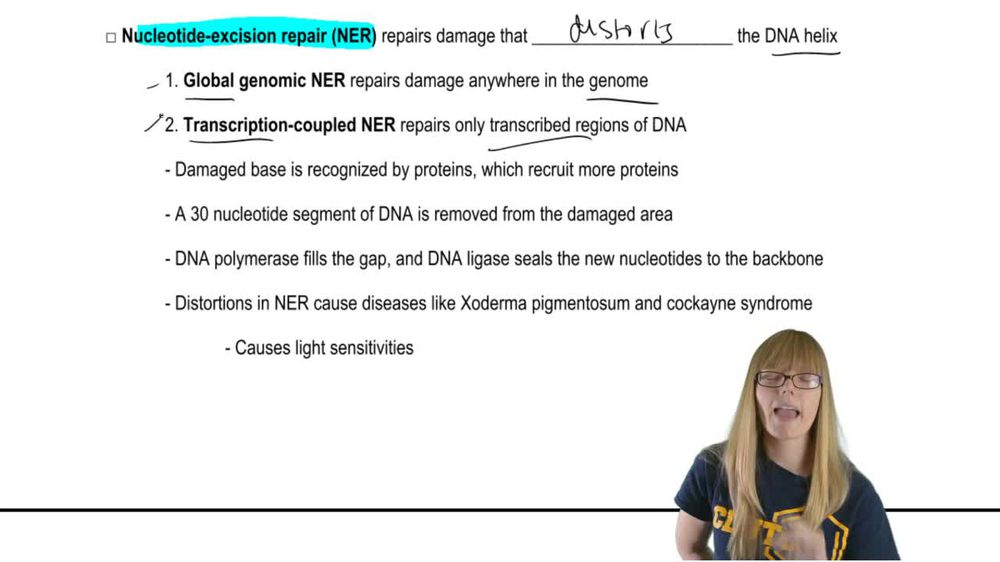 05:44
05:44The partial amino acid sequence of a wild-type protein is
… Arg-Met-Tyr-Thr-Leu-Cys-Ser …
The same portion of the protein from a mutant has the sequence
… Arg-Met-Leu-Tyr-Ala-Leu-Phe …
Identify the type of mutation.
Using the adenine–thymine base pair in this DNA sequence
...GCTC...
...CGAG...
Give the sequence after a transition mutation.
A strain of E. coli is identified as having a null mutation of the RecA gene. What biological property do you expect to be absent in the mutant strain? What is the molecular basis for the missing property?
A 1-mL sample of the bacterium E. coli is exposed to ultraviolet light. The sample is used to inoculate a 500-mL flask of complete medium that allows growth of all bacterial cells. The 500-mL culture is grown on the benchtop, and two equal-sized samples are removed and plated on identical complete-medium growth plates. Plate 1 is immediately wrapped in a dark cloth, but plate 2 is not covered. Both plates are left at room temperature for 36 hours and then examined. Plate 2 is seen to contain many more growing colonies than plate 1.
Thinking about DNA repair processes, how do you explain this observation?
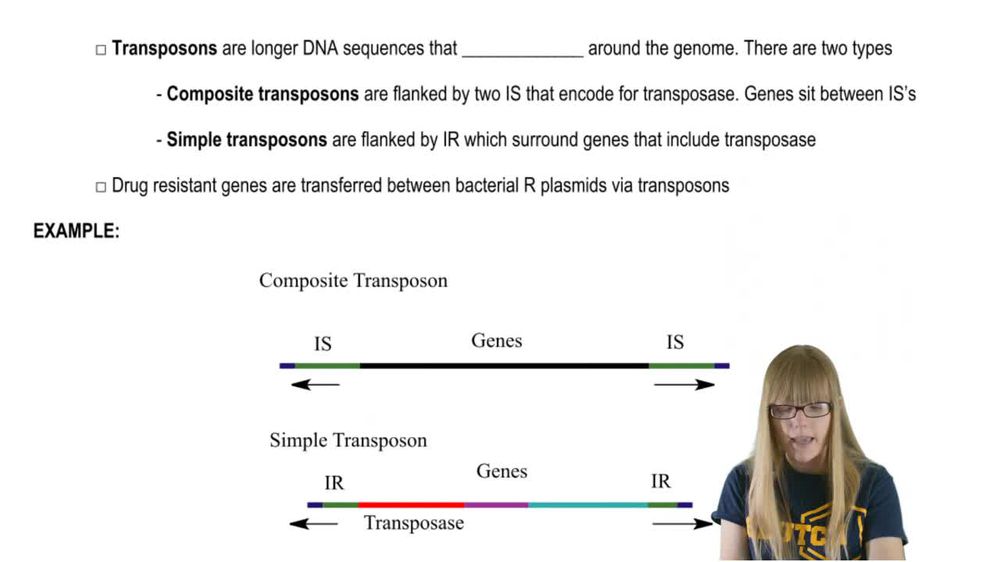
Describe the difference between DNA transposons and retrotransposons.
Using the adenine–thymine base pair in this DNA sequence
...GCTC...
...CGAG...
Give the sequence after a transversion mutation.