DNA polymerase III is the main DNA-synthesizing enzyme in bacteria. Describe how it carries out its role of elongating a strand of DNA.
Ch. 7 - DNA Structure and Replication

Sanders3rd EditionGenetic Analysis: An Integrated ApproachISBN: 9780135564172Not the one you use?Change textbook
Chapter 7, Problem 11b
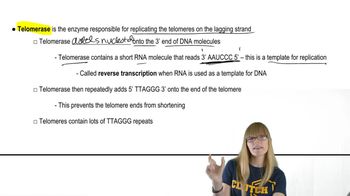
There is a problem completing the replication of linear chromosomes at their ends. What is the function of telomerase, and how does it operate to synthesize telomeres?
Verified step by step guidance1
Understand the problem: Linear chromosomes face an issue during replication because DNA polymerase cannot fully replicate the ends of the lagging strand, leading to progressive shortening of chromosomes with each cell division. This is known as the 'end-replication problem.'
Learn the role of telomerase: Telomerase is an enzyme that solves the end-replication problem by adding repetitive nucleotide sequences (telomeres) to the ends of linear chromosomes, preventing their shortening and maintaining genomic stability.
Explore the structure of telomerase: Telomerase is a ribonucleoprotein complex composed of a protein component (telomerase reverse transcriptase, TERT) and an RNA component (TERC). The RNA component serves as a template for synthesizing telomeric DNA.
Understand the mechanism of telomerase action: Telomerase binds to the overhanging single-stranded DNA at the end of the chromosome. Using its RNA template, it synthesizes complementary DNA sequences through reverse transcription, extending the telomere region.
Learn the significance of telomerase activity: Telomerase is highly active in germ cells, stem cells, and certain cancer cells, ensuring their ability to divide indefinitely. In most somatic cells, telomerase activity is low or absent, leading to gradual telomere shortening and cellular aging.

Verified video answer for a similar problem:
This video solution was recommended by our tutors as helpful for the problem above.
Video duration:
2mWas this helpful?
Key Concepts
Here are the essential concepts you must grasp in order to answer the question correctly.
Telomeres
Telomeres are repetitive nucleotide sequences located at the ends of linear chromosomes. They protect the chromosome from deterioration or fusion with neighboring chromosomes, which is crucial for maintaining genomic stability. Each time a cell divides, telomeres shorten, and when they become too short, the cell can no longer divide, leading to cellular aging.
Recommended video:
Guided course
Telomeres and Telomerase
Telomerase
Telomerase is an enzyme that adds nucleotide sequences to the ends of telomeres, counteracting the shortening that occurs during DNA replication. It is composed of a protein component and an RNA template that guides the addition of telomeric repeats. Telomerase is particularly active in stem cells and cancer cells, allowing them to maintain telomere length and continue dividing.
Recommended video:
Guided course
Telomeres and Telomerase
Mechanism of Telomerase Action
Telomerase operates by binding to the 3' end of a telomere and extending it using its RNA template. This process involves reverse transcription, where the RNA sequence is used to synthesize DNA. By elongating the telomeres, telomerase helps prevent the loss of essential genetic information during cell division, thus playing a critical role in cellular longevity and proliferation.
Recommended video:
Guided course
Telomeres and Telomerase
Related Practice
Textbook Question
551
views
Textbook Question
There is a problem completing the replication of linear chromosomes at their ends. Describe the problem and identify why telomeres shorten in each replication cycle.
552
views
Textbook Question
Explain how RNA participates in DNA replication.
768
views
Textbook Question
Consider the sequence 3'-ACGCTACGTC-5'.
What is the total number of noncovalent bonds joining the nucleotides of the complementary strands?
595
views
Textbook Question
Bacterial DNA polymerase I and DNA polymerase III perform different functions during DNA replication.
Identify the principal functions of each molecule.
606
views
Textbook Question
A sample of double-stranded DNA is found to contain 20% cytosine. Determine the percentage of the three other DNA nucleotides in the sample.
593
views