Through a forward genetics screen in Arabidopsis you have identified a mutation that results in leaves curling upward, rather than being flat as in wild type. You have cloned the corresponding gene and note that it is a member of a small gene family composed of three additional members in Arabidopsis. How will you determine if the other three members of the gene family have similar or distinct functions as compared with the gene you first identified?
Ch. 14 - Analysis of Gene Function via Forward Genetics and Reverse Genetics

Sanders3rd EditionGenetic Analysis: An Integrated ApproachISBN: 9780135564172Not the one you use?Change textbook
All textbooks
Sanders 3rd Edition
Ch. 14 - Analysis of Gene Function via Forward Genetics and Reverse Genetics
Problem 34
Sanders 3rd Edition
Ch. 14 - Analysis of Gene Function via Forward Genetics and Reverse Genetics
Problem 34Chapter 14, Problem 34
How might you use CRISPR–Cas9 to create a large deletion?
Verified step by step guidance1
Identify the target region in the genome where the large deletion is desired. Use bioinformatics tools to locate the specific DNA sequence and design guide RNAs (gRNAs) that flank the region to be deleted.
Design two guide RNAs (gRNAs): one that targets the upstream boundary of the region to be deleted and another that targets the downstream boundary. Ensure the gRNAs are specific to the target sequences to minimize off-target effects.
Introduce the CRISPR–Cas9 system into the target cells. This includes delivering the Cas9 protein (or its gene) and the two gRNAs into the cells using a suitable delivery method, such as electroporation, viral vectors, or lipid nanoparticles.
Once inside the cell, the Cas9 protein, guided by the gRNAs, will create double-strand breaks (DSBs) at the two target sites. The cell's repair machinery will attempt to repair the DSBs, and during this process, the DNA segment between the two breaks may be deleted.
Verify the deletion by extracting DNA from the modified cells and performing PCR (polymerase chain reaction) with primers that flank the deleted region. If the deletion is successful, the PCR product will be shorter than the original sequence. Confirm the deletion further using sequencing.

Verified video answer for a similar problem:
This video solution was recommended by our tutors as helpful for the problem above.
Video duration:
1mWas this helpful?
Key Concepts
Here are the essential concepts you must grasp in order to answer the question correctly.
CRISPR-Cas9 Mechanism
CRISPR-Cas9 is a revolutionary gene-editing technology that allows for precise modifications in DNA. It utilizes a guide RNA to direct the Cas9 enzyme to a specific location in the genome, where it creates a double-strand break. This break can then be repaired by the cell's natural repair mechanisms, which can lead to insertions, deletions, or modifications of the genetic material.
Recommended video:
Guided course
Regulation
Large Deletions
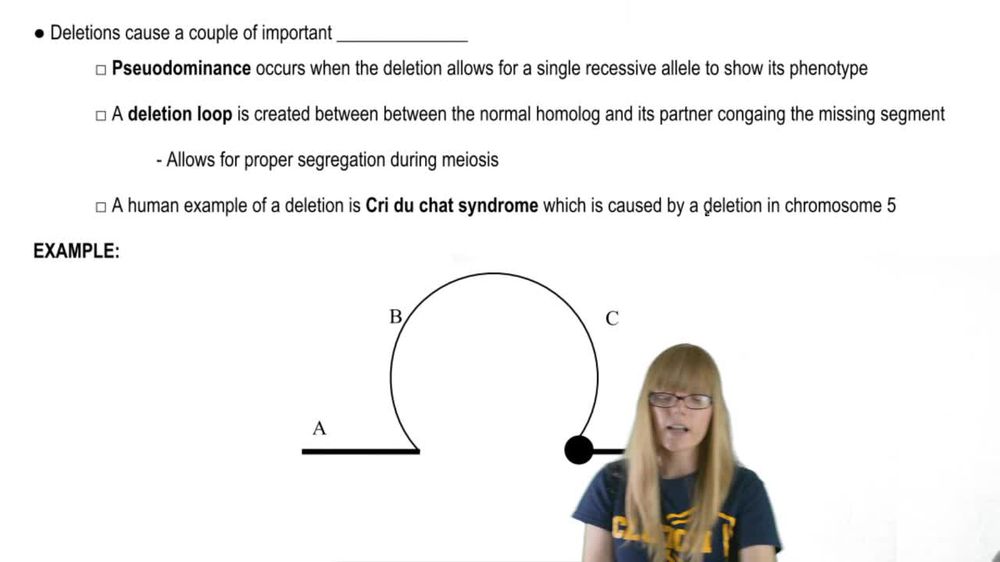
Large deletions refer to the removal of significant segments of DNA from the genome. In the context of CRISPR-Cas9, creating a large deletion typically involves designing two guide RNAs that target sequences flanking the region to be deleted. When both guides direct Cas9 to cut at their respective sites, the intervening DNA can be excised during the repair process, resulting in a deletion.
Recommended video:
Guided course
Deletions
Homology-Directed Repair (HDR) and Non-Homologous End Joining (NHEJ)
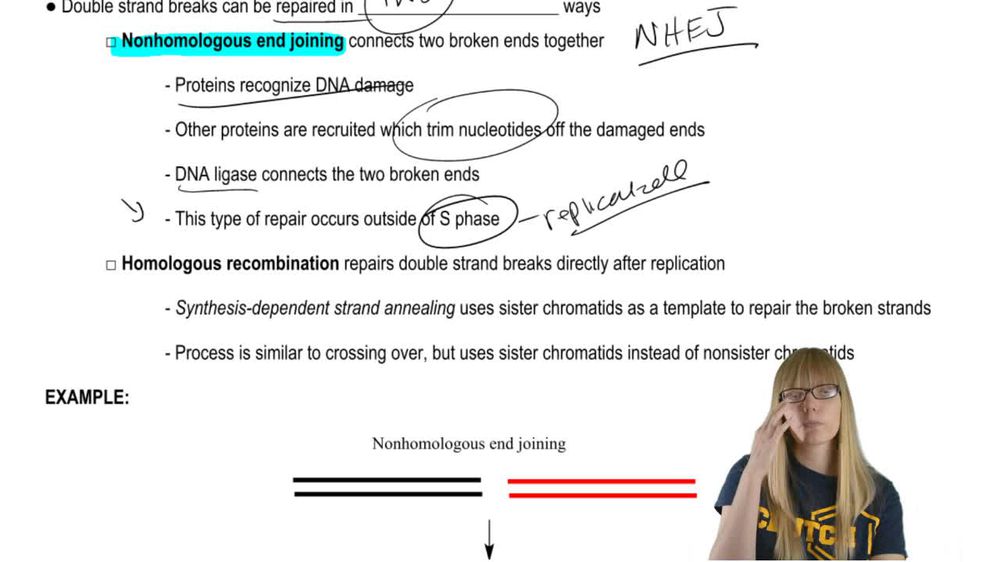
After CRISPR-Cas9 induces a double-strand break, the cell can repair the break through two main pathways: Homology-Directed Repair (HDR) and Non-Homologous End Joining (NHEJ). HDR can be used to introduce specific changes if a template is provided, while NHEJ often leads to insertions or deletions (indels) at the break site. For large deletions, NHEJ is typically the pathway utilized, as it can result in the removal of the DNA between two cut sites.
Recommended video:
Guided course
Double Strand Breaks
Related Practice
Textbook Question
427
views
Textbook Question
The CRISPR–Cas9 complex directs the Cas9 endonuclease to a specific genomic locus. If the endonuclease domain is inactivated and replaced with a transcriptional activator (or repressor) domain, what would be the functional consequence of directing such a complex to a specific chromosomal location?
662
views
Textbook Question
How would you edit a specific nucleotide in a genome?
647
views