
Textbook Question
How is positional information provided along the anterior–posterior axis in Drosophila? What are the functions of bicoid and nanos?
515
views

 Verified step by step guidance
 09:16
09:16
 08:55
08:55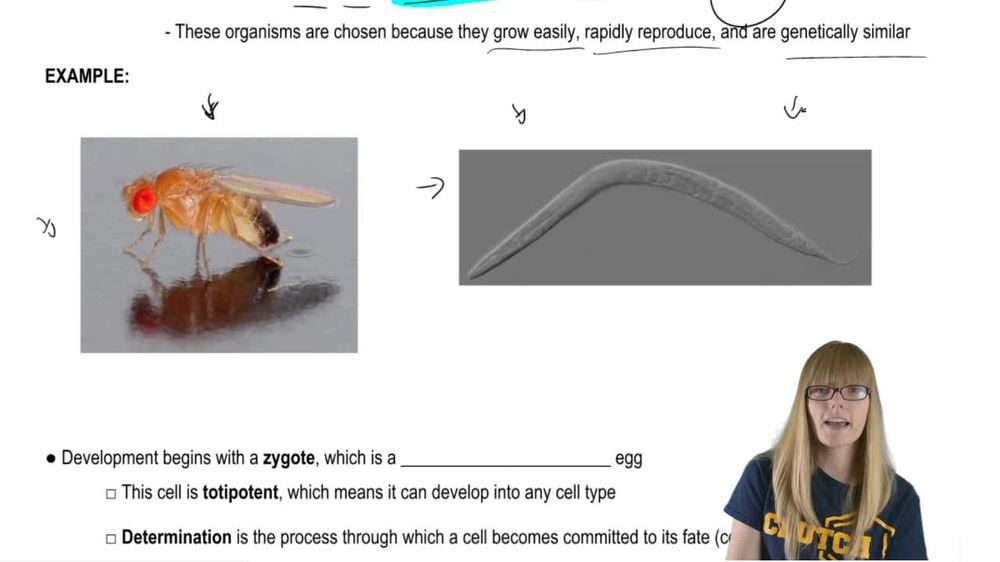 08:30
08:30How is positional information provided along the anterior–posterior axis in Drosophila? What are the functions of bicoid and nanos?
Early development in Drosophila is atypical in that pattern formation takes place in a syncytial blastoderm, allowing free diffusion of transcription factors between nuclei. In many other animal species, the fertilized egg is divided by cellular cleavages into a larger and larger number of smaller and smaller cells.
What constraints does the formation of a syncytial blastoderm impose on the mechanisms of pattern formation?
Bird beaks develop from an embryonic group of cells called neural crest cells that are part of the neural tube, which gives rise to the spinal column and related structures. Amazingly, neural crest cells can be surgically transplanted from one embryo to another, even between embryos of different species. When quail neural crest cells were transplanted into duck embryos, the beak of the host embryo developed into a shape similar to that found in quails, creating the 'quck.' Duck cells were recruited in addition to the quail cells to form part of the quck beak. Conversely, when duck neural crest cells were transplanted into quail embryos, the beak of the embryo resembled that of a duck, creating a 'duail,' and quail cells were recruited to form part of the beak. What do these experiments tell you about the autonomy or nonautonomy of the transplanted and host cells during beak development?