If a man and a woman are each heterozygous carriers of a mutation causing a disease on the RUSP list, what do you think are the three or four most important factors they should consider in their decision making about having children?
Ch. 9 - The Molecular Biology of Translation

Sanders3rd EditionGenetic Analysis: An Integrated ApproachISBN: 9780135564172Not the one you use?Change textbook
Chapter 9, Problem 8
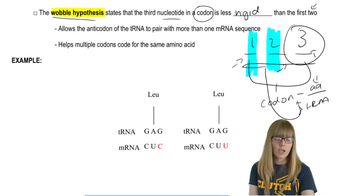
For each of the anticodon sequences given in the previous problem, identify the other codon sequence to which it could potentially pair using third base wobble.
Verified step by step guidance1
Identify the anticodon sequence provided in the previous problem.
Recall that the anticodon is complementary to the mRNA codon, and it pairs with the mRNA during translation.
Understand the concept of wobble base pairing, which allows for flexibility in the pairing of the third base of the codon with the first base of the anticodon.
Determine the possible codons that can pair with the given anticodon by considering the standard base pairing rules (A-U, G-C) and the wobble rules (G can pair with U, I can pair with A, U, or C).
List the potential codon sequences that could pair with the anticodon, taking into account the wobble base pairing possibilities.

Verified video answer for a similar problem:
This video solution was recommended by our tutors as helpful for the problem above.
Video duration:
2mWas this helpful?
Key Concepts
Here are the essential concepts you must grasp in order to answer the question correctly.
Anticodon and Codon Pairing
Anticodons are sequences of three nucleotides in tRNA that pair with complementary codons in mRNA during translation. Each codon in mRNA corresponds to a specific amino acid, and the pairing is crucial for accurate protein synthesis. Understanding how anticodons match with codons is essential for interpreting genetic information.
Recommended video:
Guided course
Translation:Wobble Hypothesis
Wobble Hypothesis
The wobble hypothesis explains how the third base of a codon can be less specific in pairing with the corresponding anticodon. This flexibility allows a single tRNA to recognize multiple codons that code for the same amino acid, enhancing the efficiency of protein synthesis. This concept is vital for understanding the redundancy in the genetic code.
Recommended video:
Guided course
Translation:Wobble Hypothesis
Genetic Code Redundancy
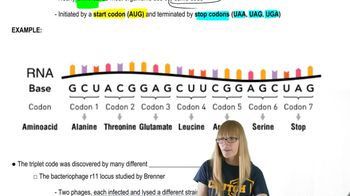
The genetic code is described as redundant because multiple codons can encode the same amino acid. This redundancy is a result of the 64 possible codons (combinations of three nucleotides) coding for only 20 amino acids. Recognizing this redundancy is important for predicting how different codons can pair with anticodons, especially when considering wobble pairing.
Recommended video:
Guided course
The Genetic Code
Related Practice
Textbook Question
650
views
Textbook Question
Identify the amino acid carried by tRNAs with the following anticodon sequences.
5′-GAU-3′
543
views
Textbook Question
What is the role of codons UAA, UGA, and UAG in translation? What events occur when one of these codons appears at the A site of the ribosome?
1183
views
Textbook Question
Compare and contrast the composition and structure of bacterial and eukaryotic ribosomes, identifying at least three features that are the same and three features that are unique to each type of ribosome.
573
views
Textbook Question
Identify the amino acid carried by tRNAs with the following anticodon sequences.
5′-CUC-3′
508
views
Textbook Question
Identify the amino acid carried by tRNAs with the following anticodon sequences.
5′-AUG-3′
595
views
