Ch.12 - Solids and Modern Materials
Brown - Chemistry: The Central Science 14th Edition
Brown14th EditionChemistry: The Central ScienceISBN: 9780134414232Not the one you use?Change textbook
Chapter 12, Problem 15c

Indicate the type of solid (molecular, metallic, ionic, or covalent-network) for each compound: (c) Ta2O5 (melting point, 1872°C)

Verified step by step guidance
1
Identify the elements present in Ta2O5: Tantalum (Ta) and Oxygen (O).
Consider the nature of the bond between Ta and O. Tantalum is a metal and oxygen is a non-metal, suggesting ionic character.
Evaluate the melting point: A high melting point (1872°C) is characteristic of ionic or covalent-network solids.
Consider the structure: Ta2O5 is likely to form a lattice structure typical of ionic compounds.
Conclude that Ta2O5 is an ionic solid due to the metal-nonmetal combination and high melting point.

Verified video answer for a similar problem:

This video solution was recommended by our tutors as helpful for the problem above.
Video duration:
59s
Was this helpful?

Key Concepts

Here are the essential concepts you must grasp in order to answer the question correctly.

Types of Solids

Solids can be classified into four main types: molecular, metallic, ionic, and covalent-network. Molecular solids consist of molecules held together by intermolecular forces, metallic solids are composed of metal atoms sharing electrons, ionic solids are formed from the electrostatic attraction between oppositely charged ions, and covalent-network solids consist of a continuous network of covalent bonds.
Recommended video:
Guided course
01:31
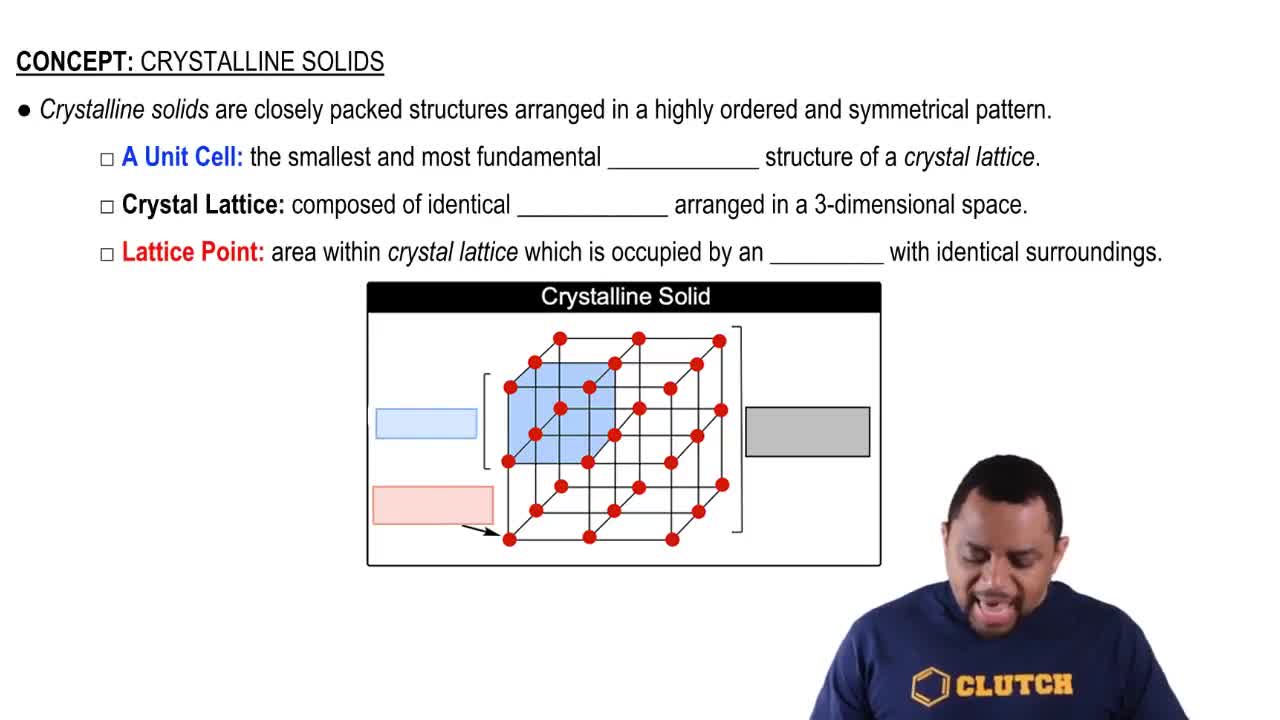
Crystalline Solids Structure

Ionic Compounds

Ionic compounds are formed when metals transfer electrons to nonmetals, resulting in the formation of positively and negatively charged ions. These ions are held together by strong electrostatic forces, leading to high melting and boiling points. The structure of ionic compounds is typically crystalline, and they often dissolve in water, conducting electricity in solution.
Recommended video:
Guided course
02:11
Ionic Compounds Naming

Melting Point and Bonding

The melting point of a solid is indicative of the strength of the forces holding its particles together. Higher melting points generally suggest stronger bonding interactions. For example, ionic compounds like Ta2O5 exhibit high melting points due to the strong ionic bonds between the Ta and O ions, reflecting their stability and the energy required to break these interactions.
Recommended video:
Guided course
04:29
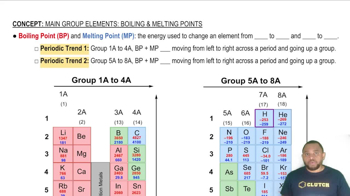
Boiling Point and Melting Point