Draw sketches illustrating the overlap between the following orbitals on two atoms: (a) the 2s orbital on each atom
Ch.9 - Molecular Geometry and Bonding Theories
Brown14th EditionChemistry: The Central ScienceISBN: 9780134414232Not the one you use?Change textbook
Chapter 9, Problem 47d
For each statement, indicate whether it is true or false. (d) Nonbonding electron pairs cannot occupy a hybrid orbital.
Verified step by step guidance1
Understand the concept of hybrid orbitals: Hybrid orbitals are formed by the mixing of atomic orbitals in an atom to form new orbitals that can overlap to form bonds.
Recognize that hybrid orbitals can contain both bonding and nonbonding electron pairs. Nonbonding pairs, also known as lone pairs, can occupy hybrid orbitals.
Consider examples: In a water molecule (H2O), the oxygen atom has two lone pairs that occupy hybrid orbitals (sp3 hybridization).
Analyze the statement: The statement claims that nonbonding electron pairs cannot occupy a hybrid orbital, which contradicts the known behavior of lone pairs in hybridized atoms.
Conclude based on the analysis: Since nonbonding electron pairs can indeed occupy hybrid orbitals, the statement is false.

Verified video answer for a similar problem:
This video solution was recommended by our tutors as helpful for the problem above.
Video duration:
1mWas this helpful?
Key Concepts
Here are the essential concepts you must grasp in order to answer the question correctly.
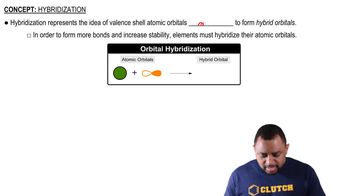
Hybridization
Hybridization is the process of combining atomic orbitals to form new hybrid orbitals that can accommodate bonding and nonbonding electron pairs. This concept is crucial for understanding molecular geometry and bonding properties in molecules, as it explains how atoms can form stable bonds with specific geometries.
Recommended video:
Guided course
Hybridization
Nonbonding Electron Pairs
Nonbonding electron pairs, also known as lone pairs, are pairs of valence electrons that are not involved in bonding. These electron pairs occupy space around the central atom and influence molecular shape and angles due to their repulsive interactions with bonding pairs, which is essential for predicting molecular geometry.
Recommended video:
Guided course
Valence Shell Electron Pair Repulsion Theory
Orbital Occupation
In molecular orbital theory, both bonding and nonbonding electron pairs can occupy hybrid orbitals. This means that nonbonding electron pairs can indeed reside in hybrid orbitals, affecting the overall shape and reactivity of the molecule. Understanding this occupation is key to determining the correct molecular geometry.
Recommended video:
Guided course
Molecular Orbital Theory
Related Practice
Textbook Question
588
views
1
rank
Textbook Question
Consider the molecule BF3. (c) What hybrid orbitals should be constructed on the B atom to make the B–F bonds in BF3?
987
views
Textbook Question
How would you expect the extent of overlap of the bondingatomic orbitals to vary in the series IF, ICl, IBr, and I2?Explain your answer.
724
views
Textbook Question
Dichloroethylene (C2H2Cl2) has three forms (isomers), each of which is a different substance. (b) Which of these isomers has a zero dipole moment?
591
views
Textbook Question
Consider the molecule BF3. (a) What is the electron configuration of an isolated B atom? (b) What is the electron configuration of an isolated F atom?
Textbook Question
Draw sketches illustrating the overlap between the following orbitals on two atoms: (b) the 2pz orbital on each atom (assume both atoms are on the z-axis) (c) the 2s orbital on one atom and the 2pz orbital on the other atom.
928
views