
A piece of dry ice (solid carbon dioxide) with a mass of 28.8 g sublimes (converts from solid to gas) into a large balloon. Assuming that all of the carbon dioxide ends up in the balloon, what is the volume of the balloon at 22 °C and a pressure of 742 mmHg?
Cyclists sometimes use pressurized carbon dioxide inflators to inflate a bicycle tire in the event of a flat. These inflators use metal cartridges that contain 16.0 g of carbon dioxide. At 298 K, to what pressure (in psi) can the carbon dioxide in the cartridge inflate a 3.45-L mountain bike tire? (Note: Assume that atmospheric pressure is 14.7 psi; the gauge pressure is the total pressure minus the atmospheric pressure.)
Verified step by step guidanceKey Concepts
Ideal Gas Law
Molar Mass of Carbon Dioxide
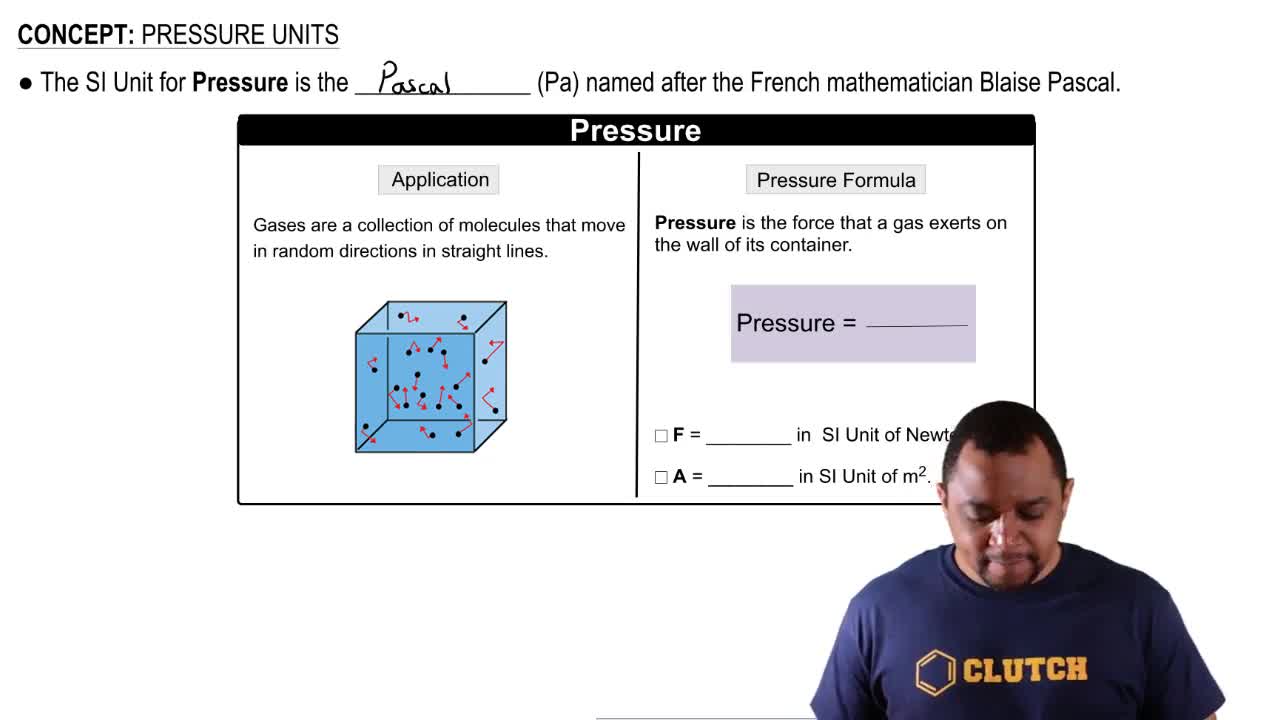
Gauge Pressure
A 1.0-L container of liquid nitrogen is kept in a closet measuring 1.0 m by 1.0 m by 2.0 m. Assuming that the container is completely full, that the temperature is 25.0 °C, and that the atmospheric pressure is 1.0 atm, calculate the percent (by volume) of air that is displaced if all of the liquid nitrogen evaporates. (Liquid nitrogen has a density of 0.807 g/mL.)
This picture represents a sample of gas at a pressure of 1 atm, a volume of 1 L, and a temperature of 25 °C. Draw a similar picture showing what would happen to the sample if the volume were reduced to 0.5 L and the temperature were increased to 250 °C. What would happen to the pressure?
Which gas sample has the greatest pressure? Assume that all the samples are at the same temperature. Explain.
Aerosol cans carry clear warnings against incineration because of the high pressures that can develop upon heating. Suppose that a can contains a residual amount of gas at a pressure of 755 mmHg and a temperature of 25 °C. What would the pressure be if the can were heated to 1155 °C?
