Ch. 53 - Ecosystems and Global Ecology
Freeman - Biological Science 8th Edition
Freeman8th EditionBiological ScienceISBN: 9780138276263Not the one you use?Change textbook
Chapter 53, Problem 5

If the GPP of a grassland is 5000 kcal/m2/year and 55 percent is used up by cellular respiration, what is the NPP?
a. 2250 kcal/m2/year
b. 2750 kcal/m2/year
c. 5000 kcal/m2/year
d. Need more data

Verified step by step guidance
1
Understand the terms: GPP (Gross Primary Productivity) is the total amount of energy captured by photosynthesis. NPP (Net Primary Productivity) is the energy that remains after cellular respiration, which is available for growth and reproduction.
Identify the given values: GPP is 5000 kcal/m²/year, and 55% of this energy is used for cellular respiration.
Calculate the energy used for cellular respiration: Multiply the GPP by the percentage used for respiration. Use the formula: Energy=GPP×0.55
Determine the NPP: Subtract the energy used for cellular respiration from the GPP. Use the formula: NPP=GPP-Energy
Review the options: Compare your calculated NPP with the given choices to identify the correct answer.

Verified video answer for a similar problem:

This video solution was recommended by our tutors as helpful for the problem above.
Video duration:
1m
Was this helpful?

Key Concepts

Here are the essential concepts you must grasp in order to answer the question correctly.

Gross Primary Productivity (GPP)

Gross Primary Productivity (GPP) is the total amount of energy captured by photosynthesis in an ecosystem, measured over a specific area and time period. It represents the total energy available before any is used for cellular respiration by producers. In this question, GPP is given as 5000 kcal/m2/year.
Recommended video:
Guided course
04:36
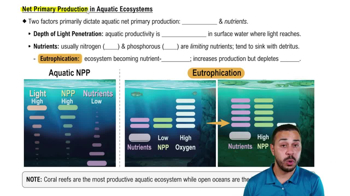
Primary Production in Aquatic Ecosystems

Net Primary Productivity (NPP)

Net Primary Productivity (NPP) is the amount of energy that remains after producers have used some for cellular respiration. It represents the energy available for growth and consumption by herbivores and decomposers. NPP is calculated by subtracting the energy used in respiration from the GPP. In this scenario, NPP can be calculated as 5000 kcal/m2/year minus 55% used for respiration.
Recommended video:
Guided course
04:36
Primary Production in Aquatic Ecosystems

Cellular Respiration in Producers

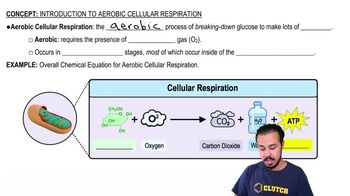
Cellular respiration in producers is the process by which plants convert glucose and oxygen into energy, releasing carbon dioxide and water as byproducts. This energy is used for metabolic activities and growth. In the context of the question, 55% of the GPP is used for cellular respiration, which is essential for calculating the NPP.
Recommended video:
Guided course
03:39
Introduction to Cellular Respiration