Ch. 6 - Inverse Circular Functions and Trigonometric Equations
Lial - Trigonometry 12th Edition
Lial12th EditionTrigonometryISBN: 9780136552161Not the one you use?Change textbook
Chapter 7, Problem 23

Evaluate each expression without using a calculator.
cos (arccos (-1))

Verified step by step guidance
1
Recognize that the expression involves the composition of the cosine function and its inverse, arccosine. Specifically, you have \(\cos(\arccos(x))\), where \(x = -1\) in this case.
Recall the definition of the arccosine function: \(\arccos(x)\) gives the angle \(\theta\) in the range \([0, \pi]\) such that \(\cos(\theta) = x\).
Apply this definition to \(\arccos(-1)\), which means finding the angle \(\theta\) where \(\cos(\theta) = -1\) and \(\theta\) is between \(0\) and \(\pi\).
Identify the angle \(\theta\) that satisfies \(\cos(\theta) = -1\) within the principal range of arccosine. This angle is a well-known special angle on the unit circle.
Finally, substitute back into the original expression: \(\cos(\arccos(-1)) = \cos(\theta)\). Since \(\theta\) was chosen so that \(\cos(\theta) = -1\), the expression simplifies accordingly.

Verified video answer for a similar problem:

This video solution was recommended by our tutors as helpful for the problem above.
Was this helpful?

Key Concepts

Here are the essential concepts you must grasp in order to answer the question correctly.

Inverse Trigonometric Functions

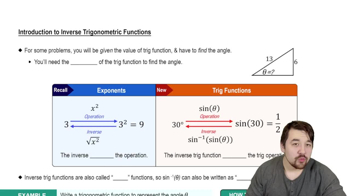
Inverse trigonometric functions, like arccos, reverse the effect of their corresponding trigonometric functions. For example, arccos(x) returns the angle whose cosine is x, typically within the range 0 to π for arccos.
Recommended video:
4:28
Introduction to Inverse Trig Functions

Cosine Function

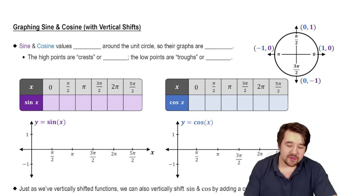
The cosine function relates an angle to the ratio of the adjacent side over the hypotenuse in a right triangle. It is periodic and defined for all real numbers, with values ranging between -1 and 1.
Recommended video:
5:53
Graph of Sine and Cosine Function

Function Composition and Simplification

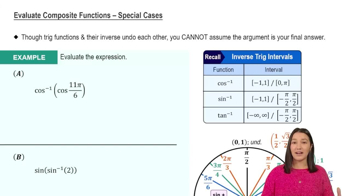
When composing a function with its inverse, such as cos(arccos(x)), the result simplifies to x within the domain of the inverse function. This property helps evaluate expressions without a calculator.
Recommended video:
3:48
Evaluate Composite Functions - Special Cases