Ch. 6 - Inverse Circular Functions and Trigonometric Equations
Lial - Trigonometry 12th Edition
Lial12th EditionTrigonometryISBN: 9780136552161Not the one you use?Change textbook
Chapter 7, Problem 21

Solve each equation for x, where x is restricted to the given interval.
y = cos (x + 3) , for x in [―3, π―3]

Verified step by step guidance
1
Identify the given equation: \(y = \cos(x + 3)\), and the interval for \(x\) is \([-3, \pi - 3]\).
Since \(y = \cos(x + 3)\), let’s introduce a substitution to simplify the expression. Define a new variable \(\theta = x + 3\).
Rewrite the interval for \(x\) in terms of \(\theta\): since \(x\) ranges from \(-3\) to \(\pi - 3\), then \(\theta = x + 3\) ranges from \(-3 + 3 = 0\) to \((\pi - 3) + 3 = \pi\). So, \(\theta \in [0, \pi]\).
Solve the equation for \(\theta\) by setting \(y = \cos(\theta)\) equal to the desired value (if given) or analyze the behavior of \(\cos(\theta)\) on the interval \([0, \pi]\). If the problem requires solving \(\cos(\theta) = y_0\), use the inverse cosine function: \(\theta = \arccos(y_0)\) and consider all solutions within \([0, \pi]\).
After finding the solutions for \(\theta\), convert back to \(x\) by using \(x = \theta - 3\). Make sure the solutions for \(x\) lie within the original interval \([-3, \pi - 3]\).

Verified video answer for a similar problem:

This video solution was recommended by our tutors as helpful for the problem above.
Was this helpful?

Key Concepts

Here are the essential concepts you must grasp in order to answer the question correctly.

Cosine Function and Its Properties

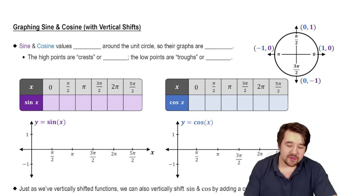
The cosine function, cos(x), is a periodic trigonometric function with period 2π. It oscillates between -1 and 1 and is even, meaning cos(-x) = cos(x). Understanding its graph and behavior helps in solving equations involving shifts and intervals.
Recommended video:
5:53
Graph of Sine and Cosine Function

Solving Trigonometric Equations

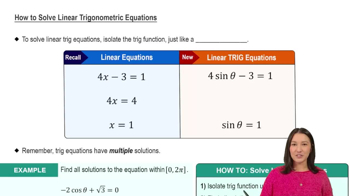
Solving equations like cos(x + 3) = y involves finding all angles x that satisfy the equation within a given interval. This requires using inverse trigonometric functions and considering the periodic nature of cosine to find all valid solutions.
Recommended video:
4:34
How to Solve Linear Trigonometric Equations

Interval Restrictions and Domain Considerations

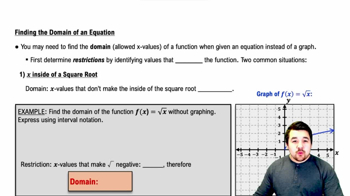
When solving trigonometric equations, restricting the variable x to a specific interval, such as [−3, π−3], limits the possible solutions. It is essential to check which solutions fall within this domain to provide the correct answer set.
Recommended video:
3:43
Finding the Domain of an Equation