Solve each equation for x, where x is restricted to the given interval. y = √2 + 3 sec 2x, for x in [0, π/4) ⋃ (π/4, π/2]
Verified step by step guidance
1
Rewrite the given equation: \(y = \sqrt{2} + 3 \sec 2x\). Our goal is to solve for \(x\) in the interval \([0, \frac{\pi}{4}) \cup (\frac{\pi}{4}, \frac{\pi}{2}]\).
Isolate the \(\sec 2x\) term by subtracting \(\sqrt{2}\) from both sides: \(y - \sqrt{2} = 3 \sec 2x\). Then divide both sides by 3 to get \(\sec 2x = \frac{y - \sqrt{2}}{3}\).
Recall that \(\sec \theta = \frac{1}{\cos \theta}\). So, rewrite the equation as \(\frac{1}{\cos 2x} = \frac{y - \sqrt{2}}{3}\), which implies \(\cos 2x = \frac{3}{y - \sqrt{2}}\).
Solve for \$2x\( by taking the inverse cosine (arccos) of both sides: \(2x = \arccos \left( \frac{3}{y - \sqrt{2}} \right)\). Remember that cosine is positive in the first and fourth quadrants, so consider all possible solutions for \)2x$ within the domain.
Finally, divide by 2 to solve for \(x\): \(x = \frac{1}{2} \arccos \left( \frac{3}{y - \sqrt{2}} \right)\). Check which solutions fall within the given interval \([0, \frac{\pi}{4}) \cup (\frac{\pi}{4}, \frac{\pi}{2}]\) and exclude any values where \(\sec 2x\) is undefined (such as at \(x = \frac{\pi}{4}\)).
Verified video answer for a similar problem:
This video solution was recommended by our tutors as helpful for the problem above
Play a video:
0 Comments
Key Concepts
Here are the essential concepts you must grasp in order to answer the question correctly.
Secant Function and Its Properties
The secant function, sec(x), is the reciprocal of the cosine function, defined as sec(x) = 1/cos(x). It is undefined where cos(x) = 0, leading to vertical asymptotes. Understanding its domain, range, and periodicity is essential for solving equations involving sec(2x).
Solving trigonometric equations involves isolating the trigonometric function and finding all angle solutions within the specified interval. This often requires using inverse functions and considering the periodic nature of trig functions to identify all valid solutions.
When solving equations, it is crucial to consider the given domain restrictions, especially when intervals exclude points where the function is undefined. Understanding interval notation and how to exclude points (like π/4 here) ensures solutions are valid within the specified range.

 Verified step by step guidance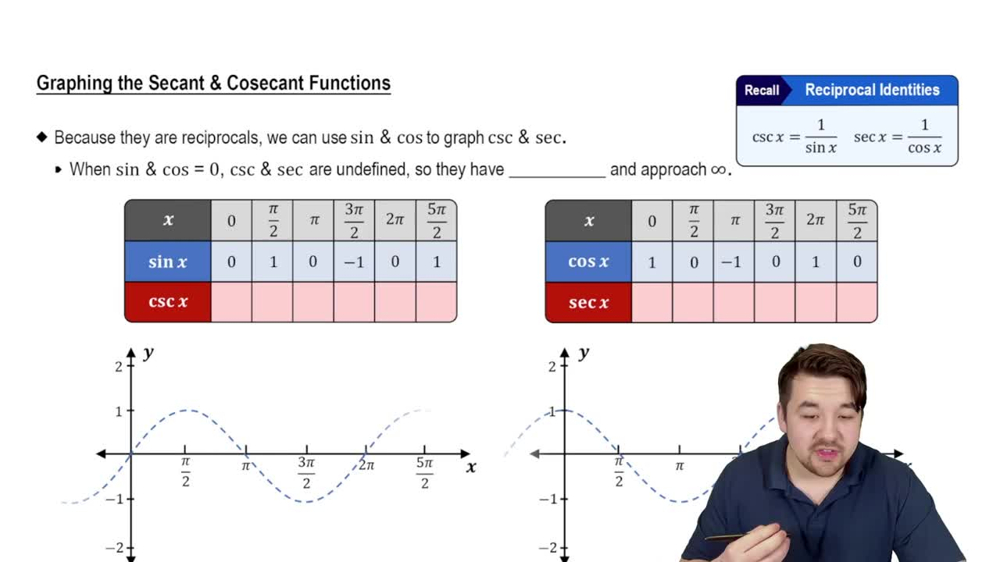
 6:22
6:22