Solve each equation for x, where x is restricted to the given interval. y = 1/2 cot 3 x , for x in [0, π/3]
Verified step by step guidance
1
Rewrite the given equation: \(y = \frac{1}{2} \cot(3x)\). To solve for \(x\), first isolate the trigonometric function by multiplying both sides by 2, giving \(2y = \cot(3x)\).
Recall the definition of the cotangent function: \(\cot \theta = \frac{\cos \theta}{\sin \theta}\). To solve for \(x\), express \(\cot(3x)\) in terms of \(y\) as \(\cot(3x) = 2y\).
Take the reciprocal to convert cotangent to tangent: \(\tan(3x) = \frac{1}{2y}\). This step is useful because tangent is often easier to invert.
Apply the inverse tangent function to both sides to solve for \$3x\(: \(3x = \arctan\left(\frac{1}{2y}\right) + k\pi\), where \)k$ is any integer, since tangent has period \(\pi\).
Finally, solve for \(x\) by dividing both sides by 3: \(x = \frac{1}{3} \arctan\left(\frac{1}{2y}\right) + \frac{k\pi}{3}\). Use the given interval \([0, \frac{\pi}{3}]\) to find all valid values of \(k\) that keep \(x\) within this range.
Verified video answer for a similar problem:
This video solution was recommended by our tutors as helpful for the problem above
Play a video:
0 Comments
Key Concepts
Here are the essential concepts you must grasp in order to answer the question correctly.
Cotangent Function and Its Properties
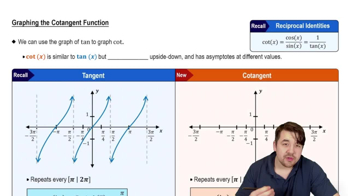
The cotangent function, cot(θ), is the reciprocal of the tangent function and is defined as cos(θ)/sin(θ). It is periodic with period π and has vertical asymptotes where sin(θ) = 0. Understanding its behavior and domain restrictions is essential for solving equations involving cotangent.
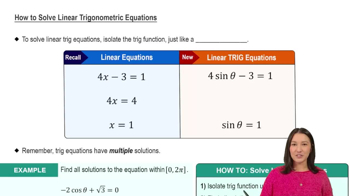
Solving trigonometric equations involves isolating the trigonometric function and finding all angle solutions within the given interval. This often requires using inverse trigonometric functions and considering the periodicity to find all valid solutions.
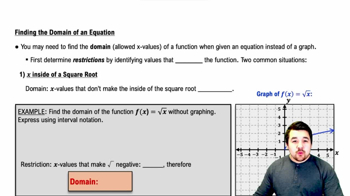
When solving for x within a specific interval, it is important to consider the domain restrictions of the function and the interval limits. Only solutions that lie within the given interval [0, π/3] are valid, which may limit the number of solutions.