In Exercises 37–52, perform the indicated operations and write the result in standard form. ___ ___ √−64 − √−25
Table of contents
- 0. Review of College Algebra4h 45m
- 1. Measuring Angles40m
- 2. Trigonometric Functions on Right Triangles2h 5m
- 3. Unit Circle1h 19m
- 4. Graphing Trigonometric Functions1h 19m
- 5. Inverse Trigonometric Functions and Basic Trigonometric Equations1h 41m
- 6. Trigonometric Identities and More Equations2h 34m
- 7. Non-Right Triangles1h 38m
- 8. Vectors2h 25m
- 9. Polar Equations2h 5m
- 10. Parametric Equations1h 6m
- 11. Graphing Complex Numbers1h 7m
11. Graphing Complex Numbers
Graphing Complex Numbers
Problem 1
Textbook Question
In Exercises 1–10, plot each complex number and find its absolute value. z = 4i
Verified step by step guidance1
Identify the complex number given: \(z = 4i\). This means the real part is 0 and the imaginary part is 4.
Plot the complex number on the complex plane, where the horizontal axis represents the real part and the vertical axis represents the imaginary part. For \(z = 4i\), plot the point at \((0, 4)\).
Recall that the absolute value (or modulus) of a complex number \(z = a + bi\) is given by the formula \(|z| = \sqrt{a^2 + b^2}\).
Substitute the values of \(a = 0\) and \(b = 4\) into the formula to express the absolute value as \(|z| = \sqrt{0^2 + 4^2}\).
Simplify the expression under the square root to find the absolute value of \(z\) (do not calculate the final numeric value here).
Verified video answer for a similar problem:This video solution was recommended by our tutors as helpful for the problem above
Video duration:
3mPlay a video:
0 Comments
Key Concepts
Here are the essential concepts you must grasp in order to answer the question correctly.
Complex Numbers and the Complex Plane
A complex number is expressed as z = a + bi, where a is the real part and b is the imaginary part. The complex plane represents these numbers graphically, with the horizontal axis for the real part and the vertical axis for the imaginary part. Plotting a complex number involves locating the point (a, b) on this plane.
Recommended video:
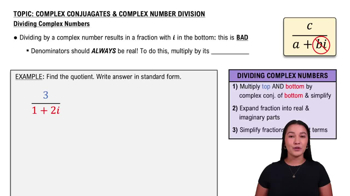
Dividing Complex Numbers
Imaginary Unit and Pure Imaginary Numbers
The imaginary unit i is defined by i² = -1. A pure imaginary number has no real part and is written as bi, where b is a real number. For example, z = 4i lies on the imaginary axis at (0, 4) in the complex plane.
Recommended video:
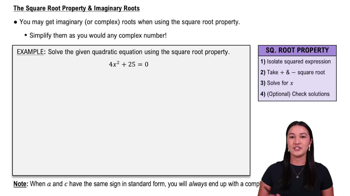
Imaginary Roots with the Square Root Property
Absolute Value (Modulus) of a Complex Number
The absolute value or modulus of a complex number z = a + bi is the distance from the origin to the point (a, b) in the complex plane. It is calculated as |z| = √(a² + b²). For z = 4i, the modulus is |4i| = √(0² + 4²) = 4.
Recommended video:
Dividing Complex Numbers
Related Videos
Related Practice
Textbook Question
586
views